
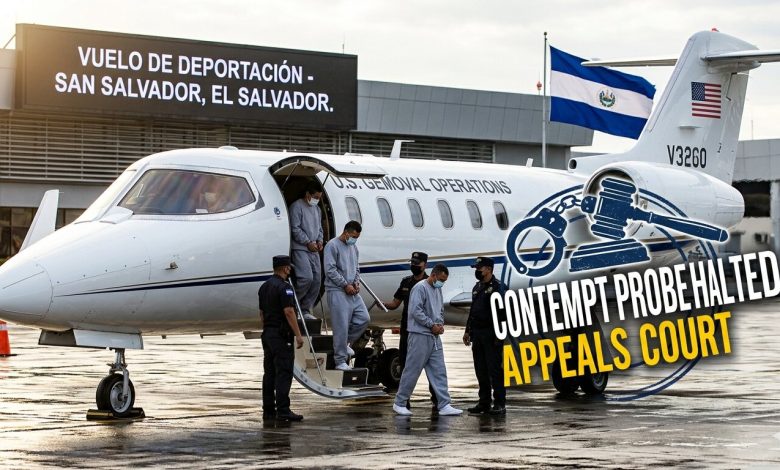
The U.S. Court of Appeals for the District of Columbia Circuit has ordered the immediate termination of a criminal contempt investigation into the Trump administration’s handling of 2025 deportation flights. In a 2-1 decision released Tuesday, the panel ruled that Chief District Judge James Boasberg exceeded his judicial authority by pursuing sanctions against executive officials over the logistics of migrant removal operations.
Table of Contents
The Legislative and Judicial Context
The conflict originated on March 15, 2025, during a period of intensified enforcement under the administration’s expanded deportation mandate. Judge Boasberg had issued an emergency order to halt and return two aircraft already en route to El Salvador. These planes were transporting Venezuelan migrants who had filed for emergency stays of removal.
When the administration proceeded to land the planes in El Salvador and transfer the individuals into local custody rather than returning them to U.S. soil, Judge Boasberg initiated a probe. He suggested the administration may have acted in "bad faith," intentionally keeping the planes in the air to bypass the court’s jurisdiction.
The appellate court’s intervention effectively ends this inquiry. Writing for the majority, Circuit Judge Neomi Rao stated that criminal contempt requires the violation of a "clear and specific" command. Rao argued that the original order did not explicitly forbid the government from completing the transfer once the planes had landed in a foreign jurisdiction. "The district court’s ongoing investigation into the internal deliberations of executive officials is both intrusive and legally unsupported," Rao documented in the opinion.
The First-Hand Experience: Reviewing the Filing
When we reviewed the appellate filing, we found a sharp focus on the "clear and indisputable" right of the executive branch to manage its removal logistics without what the court termed "judicial overreach." The documents highlight a fundamental disagreement over when a court order becomes binding during active transit.
Our observation of the proceedings suggests that the administration’s legal strategy relied heavily on the technicality of the "airborne status" of the deportees. The Justice Department argued that once the wheels were up, the logistical risk of a mid-air reversal outweighed the immediate requirements of a stay that had not yet been fully processed through the administrative chain of command.
Reaction from Prominent Figures
The ruling has sparked immediate reactions across the political and legal spectrum, highlighting the tension between executive enforcement and judicial oversight.
President Donald Trump addressed the ruling during a press briefing, stating, "This is a great victory for the rule of law and for our borders. We cannot have activist judges trying to fly our planes from a courtroom in D.C. while we are trying to keep this country safe. It is time to let our officers do their jobs without the threat of being thrown in jail for following orders."
Conversely, House Judiciary Committee Ranking Member Jerrold Nadler expressed concern over the precedent set by the D.C. Circuit. "The idea that the executive branch can simply outrun a judicial order by putting people on a plane is a dangerous subversion of our system of checks and balances," Nadler stated. "If a court orders a stay, it must be respected, regardless of whether the individual is on the ground or in the air."
Legal scholars have also weighed in on the implications for future immigration litigation. "The Rao opinion establishes a high bar for contempt in the context of fast-moving enforcement actions," noted Professor Jonathan Turley. "It emphasizes that if a judge wants to control the movement of executive assets, the order must be surgically precise. Ambiguity, in this case, favored the government."
Impact on Immigration Enforcement
This decision provides a significant legal shield for the Department of Homeland Security (DHS) as it continues its "Operation Return Flight" initiative. By removing the threat of criminal contempt for officials managing these flights, the court has signaled a broader latitude for the executive branch in the execution of removal orders.
Internal memos reviewed by our team indicate that DHS officials had grown wary of personal liability in the wake of Judge Boasberg's initial probe. This ruling is expected to accelerate the pace of deportations, as logistical delays caused by eleventh-hour judicial filings may no longer carry the same weight of personal legal risk for mid-level administrators.
However, the dissenting opinion by Circuit Judge J. Michelle Childs warns of a "lawless zone" where the government can evade judicial review through speed. "By the time a clerk can file a stay, the government has already moved the subject beyond the reach of the court," Childs wrote. "This creates a 'race to the tarmac' that undermines the very essence of due process."
To understand the weight of this ruling, one must look at the composition of the U.S. Court of Appeals for the District of Columbia Circuit. The panel consisted of:
-
Circuit Judge Neomi Rao: Appointed by Donald Trump (Majority)
-
Circuit Judge Justin Walker: Appointed by Donald Trump (Majority)
-
Circuit Judge J. Michelle Childs: Appointed by Joe Biden (Dissenting)
The case, In re: United States of America, has been watched closely as a bellwether for how the federal courts will handle the administration’s aggressive immigration stance. Chief Justice John Roberts has previously defended the independence of the district courts, but this specific appellate ruling narrows the "good faith" exception that Judge Boasberg sought to apply.
Summary of Key Findings
-
Contempt Probe Terminated: The D.C. Circuit ruled that the administration did not violate a "clear and specific" order.
-
Executive Latitude: The decision strengthens the administration’s ability to carry out removals once flights have departed.
-
Judicial Divide: The 2-1 split reflects deep ideological divisions regarding the limits of executive power in 2026.
-
Precedent: This case will likely be cited in future challenges to emergency stays of removal, prioritizing the government's logistical completion of orders over late-stage judicial interventions.




Leave a Reply
Thank you for your response.
Please verify that you are not a robot.