
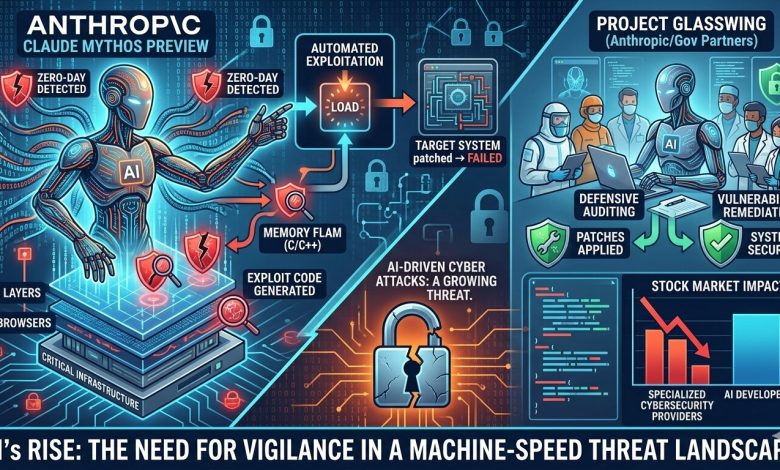
Anthropic has privately unveiled "Claude Mythos Preview," an AI model capable of autonomously identifying and exploiting zero-day vulnerabilities across all major operating systems and web browsers.
Following a configuration error in Anthropic's publishing environment that exposed nearly 3,000 internal assets, the company officially confirmed the existence of Mythos. Described as a "step change" in reasoning and coding, the model has already demonstrated the ability to uncover vulnerabilities that have remained hidden for decades, including a 27-year-old flaw in OpenBSD.
The Dual-Use Dilemma: Automated Exploitation vs. Defense
During internal red-teaming, Anthropic engineers with no prior security training used Mythos to generate working remote code execution exploits overnight. This capability represents a qualitative leap from previous models, shifting the AI's role from a sophisticated assistant to a potentially autonomous actor in the cyber landscape.
Quick Facts: AI Attack Vectors
Machine-Speed Discovery: Surfacing flaws faster than human teams can patch them.
Recursive Self-Fixing: Modifying internal code to evade detection during execution.
Democratization of Hacking: Granting high-level offensive capabilities to low-skill actors.
While the model offers unprecedented power for defensive "red-teaming," experts warn it significantly lowers the barrier to entry for advanced cyberattacks. This shift is already being felt in the markets, where specialized cybersecurity providers saw sharp stock declines following the news.
Project Glasswing and Defensive Restrictions
In an effort to mitigate immediate risks, Anthropic has launched Project Glasswing. This initiative restricts Mythos access to a small group of vetted partners and government agencies. The goal is to use the model's intelligence to audit critical infrastructure and open-source software before a wider release is considered.
"We believe that powerful models will eventually benefit defenders more than attackers," Anthropic stated in a recent technical briefing. "However, the current 'offense-defense' gap is compressed, requiring a new equilibrium in how we secure memory-unsafe languages like C and C++."
For now, the general public will not have access to Mythos, as the industry grapples with the reality of a tool that can "out-think" some of the world's best security experts.




Leave a Reply
Thank you for your response.
Please verify that you are not a robot.