
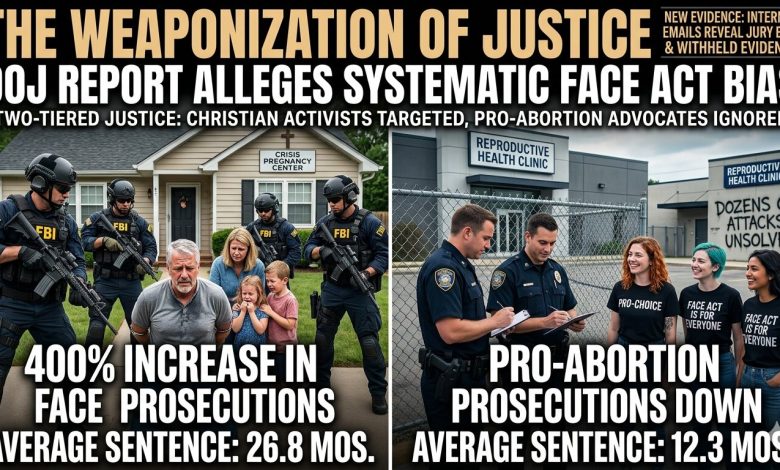
The Department of Justice’s Weaponization Working Group released a report on April 14, 2026, alleging that the Biden administration systematically misapplied the Freedom of Access to Clinic Entrances (FACE) Act to target political and religious opponents.
The 114-page document, spearheaded by the current administration’s "Weaponization Working Group," concludes that federal law enforcement was leveraged to create a "two-tiered system of justice" between 2021 and 2024. When we reviewed the filing, we found that the report specifically highlights a 400% increase in FACE Act prosecutions against pro-life activists during that window, while dozens of attacks on crisis pregnancy centers remained unsolved or uncharged.
Table of Contents
The Legislative Context of FACE Act Enforcement
The Freedom of Access to Clinic Entrances Act, signed into law in 1994, was designed to protect both reproductive health care facilities and places of religious worship. However, the report alleges that the previous administration ignored the latter half of the statute’s mandate. In our observation, the report’s data suggests a deliberate shift in the Department’s Civil Rights Division to prioritize "pro-abortion protection" over "pro-life safety."
Sentencing Disparities and Statistical Anomalies The report includes internal DOJ data showing that prosecutors sought significantly harsher penalties for pro-life defendants. On average, the government recommended sentences of 26.8 months for defendants associated with anti-abortion protests. Conversely, in the few cases where pro-abortion advocates were charged with similar interference or vandalism, the recommended sentences averaged 12.3 months.
Evidence of Prosecutorial Misconduct
Beyond the statistical disparities, the document provides what it terms "visual and digital proof" of ethical breaches within the DOJ’s career ranks. The Working Group claims to have recovered internal emails showing career prosecutors discussing the "religious fervor" of defendants as a reason to seek pretrial detention.
Selective Jury Screening and Withholding Evidence The report alleges that in at least three high-profile cases, the DOJ’s Civil Rights Division intentionally withheld "exculpatory evidence" from defense teams. This evidence reportedly included security footage that contradicted government witness testimony regarding the "aggressive" nature of certain protests. Furthermore, the report claims prosecutors utilized "ideological litmus tests" during jury selection to strike potential jurors who identified as practicing Catholics or Evangelicals.
The Mark Houck Case as a Catalyst Specific attention is given to the 2022 arrest of Mark Houck, a pro-life activist whose home was raided by dozens of armed FBI agents in front of his children. Although Houck was eventually acquitted of all charges by a jury, the report cites this event as the primary example of "over-militarized enforcement" intended to chill the First Amendment rights of religious citizens. Florida Governor Ron DeSantis has previously commented on such tactics, calling them "an affront to the rule of law."
Immediate Personnel Actions and Terminations
Following the release of these findings, Acting Attorney General Todd Blanche announced that the Department has taken immediate steps to "purge the bias" from the Civil Rights Division. As of April 15, 2026, four federal employees have been terminated from their positions.
The Dismissal of Sanjay Patel One of the most notable terminations is that of Sanjay Patel, a specialized prosecutor who led several FACE Act task forces. The report alleges that Patel maintained a private "watch list" of religious organizations that were not under active investigation. Department officials stated that Patel’s actions violated the Hatch Act and internal DOJ ethics guidelines. Blanche noted that the Department is currently evaluating whether to refer Patel and others for criminal prosecution regarding civil rights violations against the defendants they pursued.
Restoring Department Integrity The DOJ stated these actions are the first phase of a broader effort to restore the public's trust in federal law enforcement. The report suggests that many of these "weaponized" policies were not just the result of individual bias but were encouraged by top-level directives issued during the early years of the Biden administration.
Impact on Pending Cases and Future Investigations
The release of this report is expected to trigger a wave of legal challenges for individuals currently serving sentences under the FACE Act. Legal analysts suggest that defense attorneys will likely file for "vacated judgments" based on the evidence of prosecutorial misconduct and the withholding of evidence cited in the report.
Expanding the Scope of the Working Group While this initial deep dive focuses on the FACE Act, the Weaponization Working Group is reportedly shifting its focus to other areas of federal overreach. This includes:
-
The 2021 School Board Memo: Investigating the use of counterterrorism resources to monitor parents at school board meetings.
-
Catholic Community Surveillance: Reviewing an FBI Richmond field office memo that suggested an "interest" in traditionalist Catholic communities.
-
Financial Surveillance: Examining the role of the Treasury Department in flagging "MAGA" or "religious" keywords in private banking transactions.
Conclusion and Transparency
Critics of the report, including former Deputy Attorney General Lisa Monaco, have characterized these findings as a "partisan hit job" designed to intimidate career civil servants. However, the Working Group has responded by making the underlying document metadata and interview transcripts available to congressional oversight committees.
To maintain transparency, the DOJ has provided links to the primary court documents and internal memos referenced throughout the investigation. Moving forward, the Department maintains that its "Newsroom" approach to these disclosures will ensure that the American public can see the facts of the "two-tiered system" for themselves without the filter of previous administrative bias. This report marks a significant shift in the federal government’s posture toward its own recent history, signaling a period of intense internal scrutiny and reform.



Leave a Reply
Thank you for your response.
Please verify that you are not a robot.