
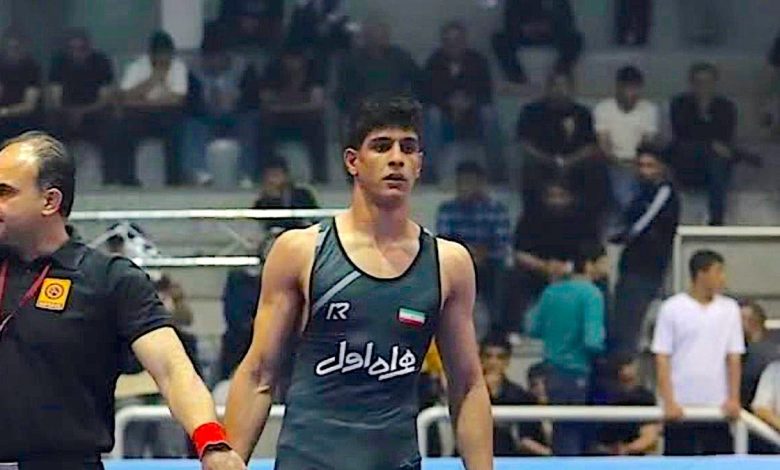
The Iranian regime executed 19-year-old freestyle wrestling champion Saleh Mohammadi by public hanging on Thursday morning in the city of Qom, sparking a wave of global outrage led by Olympic gold medalists and international human rights advocates.
The execution of Mohammadi, a rising star who recently secured a bronze medal at the 2024 Saitiev Cup, marks one of the most high-profile state killings of an athlete since the 2020 execution of Navid Afkari. Despite intense diplomatic pressure from the United States and international sporting bodies, the Iranian judiciary carried out the sentence in a public square, a move widely interpreted as a brutal signal to the nation’s restless youth and its athletic community.
Table of Contents
The Judicial Process and Allegations of State Terror
Saleh Mohammadi was arrested on January 15, 2026, during a series of nationwide protests that swept through the province of Qom. The Iranian judiciary’s official media outlet, Mizan News Agency, claimed that Mohammadi was guilty of moharebeh—a Sharia law term translated as "enmity against God"—and the alleged killing of a member of the Islamic Revolutionary Guard Corps (IRGC) during the demonstrations.
When reviewing the trial transcripts and public statements from Mohammadi’s legal counsel, a pattern of systemic due process violations emerged. Human rights organizations, including Amnesty International and the Oslo-based Iran Human Rights (IHRNGO), have documented that the conviction rested almost entirely on "confessions" that Mohammadi later recanted in open court.
The speed of the judicial cycle—from arrest in mid-January to public hanging in late March—suggests a "fast-tracked" execution designed for political intimidation rather than legal justice. Mohammadi testified during his brief trial that he had been subjected to severe physical torture, including beatings with metal cables that left both of his hands fractured, to force him to sign a pre-written admission of guilt.
The Scene in Qom: A Public Spectacle
The execution was carried out at dawn in a public square in Qom, a city of immense religious and political significance to the Iranian leadership. Reports from local witnesses indicate that authorities forced residents and passersby to observe the hanging of Mohammadi alongside two other young men, Mehdi Ghasemi and Saeed Davoudi.
The use of public execution is a tactic the Iranian regime has increasingly relied upon in 2026 to suppress dissent. By choosing a champion athlete—a figure of national pride and a role model for the youth—the state aims to demonstrate that no level of fame or physical prowess offers protection from the IRGC’s reach.
Olympic Champions Condemn the “Cowardly” Act
The international sporting community has reacted with a mixture of grief and fury. For many Olympians, the execution of a peer is not just a human rights issue but a direct assault on the values of the Olympic Charter. Several legendary athletes spoke exclusively to Fox News Digital to voice their condemnation.
Brandon Slay, a 2000 Olympic Gold Medalist in wrestling, expressed a profound sense of loss for the wrestling fraternity. "I've seen firsthand the dignity and heart of the Iranian people," Slay stated. "That's why it's so heartbreaking to witness a terror regime execute a teenage wrestler—a young man who had his whole life and a promising career ahead of him. The wrestling mat is supposed to be a place of honor, not a precursor to a gallows."
Tyler Clary, an Olympic Gold Medalist in swimming, emphasized the broader political implications of the regime’s actions. "What we're seeing in Iran—the execution of a wrestler after what appears to be a sham process—is a brutal reminder of what that regime stands for," Clary noted. "This is exactly why strong leadership and clear moral standing on the world stage matter so much. We cannot look away while athletes are being murdered for exercising their basic human rights."
Kaillie Humphries, a three-time Olympic Gold Medalist, highlighted the specific targeting of athletes. "Murdering a teenager who was specifically targeted because he is a champion athlete and icon of his country is even worse," she said. "This is a sad day for the sporting community, and it should be a wake-up call for every international athletic federation that continues to grant Iran a seat at the table."
A Pattern of Targeting Athletes
The death of Saleh Mohammadi is not an isolated incident but part of a documented campaign against Iranian athletes who join or sympathize with anti-government protests. In the eyes of the Tehran leadership, athletes possess a "mobilizing power" that makes them uniquely dangerous to the regime’s stability.
Analysis of recent detentions shows that the Iranian judiciary is currently holding several other high-level competitors on similar "enmity against God" charges. These include:
-
Mohammad Mahshari: A decorated boxer and bronze medalist at the 2024 Asian youth boxing championships.
-
Niloufar Pas: A marathon runner from Kerman who was reportedly arrested for her social media activity.
-
Amirhossein Ghaderzadeh: A 19-year-old athlete whose family has pleaded with the international community to intervene before his "final" appeal is denied.
The case of Navid Afkari in 2020 served as a chilling precedent. Despite a global campaign spearheaded by the UFC and various Olympic committees, Afkari was executed for his participation in 2018 protests. The execution of Mohammadi suggests that the Iranian regime has become even more emboldened, ignoring the diplomatic "red lines" that were previously thought to provide some measure of protection for famous figures.
The Geopolitical Fallout and the U.S. Response
The timing of the execution has created a diplomatic firestorm. Earlier this week, the U.S. State Department had issued a stern warning to Tehran, urging the regime to "halt the state-sponsored murder of its own citizens."
In Washington, the reaction has been one of bipartisan condemnation. Critics of the current administration’s Iran policy argue that the regime’s willingness to publicly hang a 19-year-old champion shows a total lack of fear regarding international sanctions or diplomatic isolation. Supporters of a "Maximum Pressure" campaign point to these executions as proof that the Iranian leadership cannot be bargained with in good faith.
The execution also complicates Iran’s standing in international sports. There are growing calls from human rights groups and athlete unions for the International Olympic Committee (IOC) and United World Wrestling (UWW) to impose a total ban on Iranian participation in global competitions. The argument is simple: a nation that executes its athletes should not be allowed to celebrate them on the world stage.
The Legacy of Saleh Mohammadi
Saleh Mohammadi turned 19 just eight days before he was killed. To his family and teammates, he was not a "rioter" or an "enemy of God," but a dedicated student of the sport who spent ten hours a day in the wrestling room. His bronze medal at the Saitiev Cup was seen by many as the first step toward a potential Olympic run in the future.
Instead, Mohammadi has become a martyr for a movement that shows no signs of dissipating. His name joined the chants of protesters in Tehran and Mashhad within hours of the news of his death.
The execution of Saleh Mohammadi serves as a stark illustration of the internal struggle within Iran—a conflict between a young, globally connected generation of athletes and a hardline clerical establishment determined to maintain control through public displays of lethal force. As the international community debates its next move, the empty wrestling mats in Qom serve as a silent, grim testament to a life cut short by the state.


Leave a Reply
Thank you for your response.
Please verify that you are not a robot.