
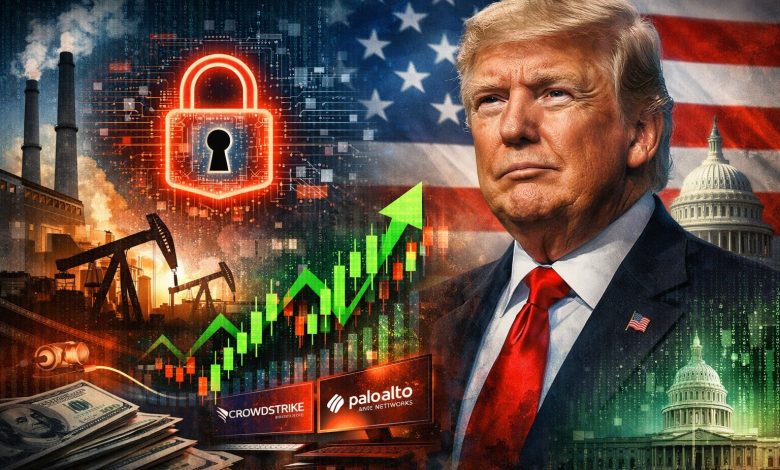
The annual RSA Conference in San Francisco is typically a showcase for the latest in threat detection and artificial intelligence. However, this year, the "hallway track" conversations and investor briefings are being dominated by a different kind of firewall: the potential shift in federal policy as the 2024 election cycle heats up. Following President Donald Trump’s recent comments regarding the expansion of American energy and the rolling back of certain federal mandates, cybersecurity stocks are seeing a surge in investor interest, driven by the belief that a second Trump administration would prioritize the protection of critical infrastructure through private-sector growth rather than heavy-handed government oversight.
Table of Contents
Market Momentum and the “Trump Factor”
Investors are increasingly viewing cybersecurity not just as a defensive necessity, but as a primary beneficiary of a shifting political landscape. According to a report by Investors Business Daily, shares of major players like CrowdStrike and Palo Alto Networks have seen renewed volatility and interest as analysts weigh the impact of potential "America First" policies on tech spending.
The core of this market movement lies in the intersection of national security and economic deregulation. Historically, the cybersecurity sector has faced a dual-edged sword: high demand due to rising global threats, but high compliance costs due to shifting federal reporting requirements. Analysts attending the RSA Conference noted that a shift toward a more business-friendly environment could allow these firms to reallocate capital from compliance departments toward rapid AI-driven innovation.
Strategic Shifts in Defense and Infrastructure
While the current administration has focused heavily on centralized reporting and public-private partnerships anchored by federal agencies, the emerging sentiment among investors suggests a pivot. The anticipation is that a different regulatory approach would emphasize:
-
Hardening the Energy Grid: With a focus on domestic energy production—specifically oil, gas, and nuclear—there is an expected windfall for cybersecurity firms that specialize in "Operational Technology" (OT). Protecting the physical valves and switches of the American power grid is becoming a top priority for investors betting on an industrial revival.
-
Reduced SEC Friction: Recent mandates requiring companies to disclose breaches within tight windows have been a point of contention. Market speculators suggest that a change in leadership could lead to a "lighter touch" from the SEC, potentially reducing the legal liability that currently haunts tech executives.
-
AI Sovereignty: As reported in the original Investors Business Daily analysis, the race for AI dominance is now viewed through the lens of national defense. Cybersecurity is no longer just about stopping hackers; it’s about ensuring the integrity of the data sets that train the next generation of American military and economic AI.
Context: The Evolving Threat Landscape
To understand why these stocks are reacting to political news, one must look at the broader geopolitical context. Over the last four years, the frequency of state-sponsored attacks from actors in Russia, China, and Iran has scaled exponentially. The "Shields Up" era of the early 2020s has transitioned into a permanent state of digital siege.
In this environment, "resilience" has replaced "prevention" as the industry's buzzword. Companies are no longer promising to keep every intruder out; they are promising that when an intruder gets in, the lights will stay on and the data will remain encrypted. This shift in strategy aligns with the broader political move toward "national resilience"—a concept that resonates with an electorate increasingly concerned about the vulnerability of domestic supply chains and digital infrastructure.
Perspectives on the Policy Pivot
The reaction to a potential "Trump Trade" in the tech sector is far from uniform.
Proponents of Deregulation: Many industry leaders argue that the current "alphabet soup" of regulatory bodies—CISA, the FBI, the SEC, and the DOJ—often issue conflicting guidance that slows down response times. They argue that a streamlined, incentive-based approach would allow the private sector to move at the "speed of the adversary."
Critics of a Policy Shift: Conversely, some national security experts worry that pulling back on federal mandates could lead to a "race to the bottom" regarding transparency. They argue that without strict reporting requirements, the public and the markets will be left in the dark about the true scale of foreign interference in the American economy.
Why the Investor Sentiment Shift Matters
This movement in cybersecurity stocks represents more than just a momentary fluctuation in the Nasdaq; it reflects a fundamental bet on the future of the American "Fortress" economy. If the market is correct, the next few years will see a massive transfer of responsibility from federal regulators to private security architects.
The significance of this cannot be overstated. When investors pour capital into CrowdStrike or Fortinet based on political projections, they are essentially betting that the private sector is better equipped to defend the nation’s digital borders than the government. This represents a return to a "defense-in-depth" philosophy where individual companies are incentivized to be their own first line of defense.
Future Outlook and Election Benchmarks
As the RSA Conference concludes, the focus shifts from the showroom floor to the campaign trail. Analysts will be watching for specific policy white papers regarding:
-
Executive Orders on Cloud Security: Will a new administration mandate that federal data be moved to "sovereign" American clouds?
-
Export Controls: How will trade policies affect the ability of American cybersecurity firms to sell their high-end AI tools abroad, particularly in Asian markets?
-
Tax Incentives: Will there be "R&D" tax credits specifically for companies that implement verified "zero-trust" architectures?
The coming months will likely see continued volatility as these questions are debated. For now, the cybersecurity market is signaling that it is ready for a regime that prioritizes industrial strength and digital autonomy over centralized bureaucratic oversight.



Leave a Reply
Thank you for your response.
Please verify that you are not a robot.