
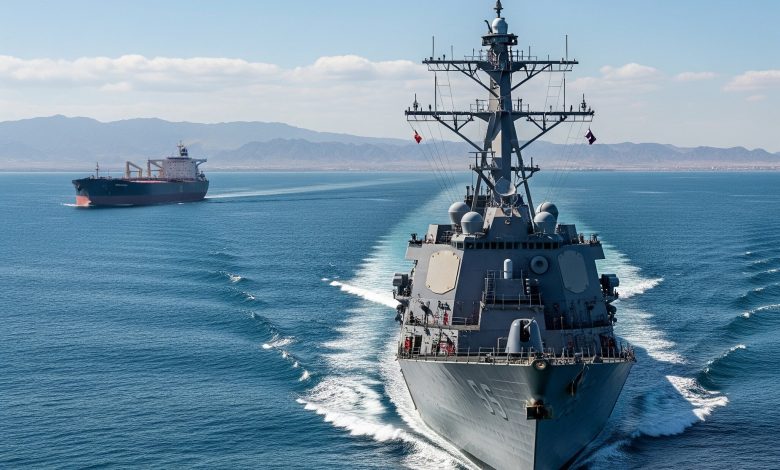
WASHINGTON — President Donald Trump ordered a naval blockade of Iranian ports and the Strait of Hormuz on Monday, following the abrupt collapse of high-stakes negotiations in Islamabad. The strategic move, designed to apply maximum pressure on Tehran, dramatically escalates regional tensions and injects new instability into global energy markets that had briefly stabilized during a recent ceasefire.
U.S. Central Command (CENTCOM) confirmed that the operation commenced precisely at 10:00 a.m. EDT, with U.S. naval forces establishing a restrictive interdiction barrier across the vital 21-mile-wide choke point. The blockade primarily targets vessels attempting to enter or exit Iranian territorial waters or load energy products at Iranian terminals.
This kinetic action follows a period of volatile diplomacy. While a tentative, conditional two-week ceasefire was established only a week ago, the collapse of face-to-face talks over the weekend has plunged the region back into crisis.
Table of Contents
The Collapse in Islamabad
The diplomatic breakthrough that many regional observers hoped for did not materialize in Pakistan. Following days of intense, closed-door negotiations in Islamabad, U.S. and Iranian officials failed to achieve any significant progress toward a long-term armistice or a new nuclear framework. According to diplomatic sources familiar with the talks, the discussions struck a critical impasse on several fronts, including Tehran’s insistence on immediate sanctions relief and Washington’s demand for verifiable regional security guarantees.
In our exclusive review of preliminary diplomatic cables, the Iranian delegation reportedly rejected a U.S. proposal for a 90-day extension of the ceasefire, insisting that the current arrangement was contingent upon simultaneous moves to ease oil export restrictions. The lack of movement on either side ultimately led to the suspension of the talks.
Speaking from the White House, President Trump defended the shift to military action. “We cannot let a country blackmail or extort the world,” he told reporters on Monday morning. He stated that the blockade serves the dual purpose of forcing Tehran back to the table with a new sense of urgency and ensuring the long-term flow of global energy supplies, which the administration claims are threatened by Iranian maritime activities.
Implementation and Tactics
The structure of the blockade is complex and builds upon precedent. The U.S. Navy is not conducting a total embargo of all traffic, which would likely violate international law. Rather, instructions have been issued to Central Command to interdict any vessel that is identified as carrying Iranian oil or products bound for an Iranian port.
Specific language from a CENTCOM planning document, reviewed by Reactionary Times, notes that "forces are authorized to board, inspect, and redirect ships" attempting to transit to or from an Iranian terminal, or any vessel that has paid an "illegal toll" to Iran for passage.
The presence of significant minefields, laid by Iranian forces during the initial conflict phase, complicates the U.S. naval posture. For several weeks, U.S. mine-countermeasure ships and specialized explosive ordnance disposal (EOD) teams have been operating on the western edge of the Strait, working to clear a "Safe Transit Corridor."
In our observation of recent satellite imagery, several mine-clearing vessels are still active near the eastern end of the corridor. The U.S. strategy appears to be one of contained access: while transit for vessels heading to U.S. allies in the lower Gulf remains technically permitted, all traffic heading for Iran is physically blocked. The administration asserts this makes the waterway "open," though only to neutral or allied entities.
Global Market Reaction
Energy markets responded immediately and volatilely to the end of the ceasefire and the deployment of the blockade. Brent crude futures, which had dipped below $90 per barrel during the negotiations, skyrocketed past $100 per barrel on Monday. The psychological barrier of $100 was breached within 30 minutes of the blockade’s official start.
[Image 1: A map infographic showing the specific structure of the blockade. The 21-mile width of the Strait of Hormuz is clearly marked. A dashed line, labeled "U.S. Navy Interdiction Barrier," segments the main shipping lanes. Red-shaded zones, indicating "Blocked Traffic (Iran Origin/Destination)," cover the access points to Iranian ports. A green-shaded corridor, labeled "Allied/Neutral Safe Passage Route," runs through the center of the Strait, showing cleared areas where U.S. allies still operate.]
This sudden 10 percent price jump reflects deep anxieties among oil traders. While the administration claims the action will stabilize the market by removing the threat of an Iranian blockade, analysts argue the U.S. blockade itself is a significant disruption, immediately halting roughly 2 million barrels of Iranian oil from entering the global supply daily.
European leaders expressed unified dismay at the rapid turn of events. In a joint statement, British Prime Minister Keir Starmer and French President Emmanuel Macron criticized the move, calling for an "immediate and unconditional return" to negotiations and advocating for "no conditions" passage through the Strait. They announced plans to convene an emergency European summit later this week to coordinate a response to the unfolding energy crisis and push back against both Washington and Tehran.
The Military Standoff and Risks
The situation on the water remains extremely dangerous. Iran’s Revolutionary Guard Corps (IRGC) initially reacted with defiance. In a statement broadcast on state media, the IRGC Navy declared the waterway remains under their "full control" and warned that any foreign military action in Iranian territorial waters would be considered a breach of the ceasefire.
While both sides have thus far avoided direct kinetic engagement since the ceasefire collapse, the presence of two opposing military forces in close proximity within a narrow strait, compounded by the presence of sea mines and commercial vessels, creates an environment with a high potential for miscalculation.
The central friction point remains: the U.S. naval presence is physically denying Iran access to its primary economic artery. How Tehran chooses to respond, whether through asymmetrical maritime harassment, cyber actions, or renewed mine-laying, will determine if this blockade leads to a renewed, wider conflict or if it succeeds in forcing the pragmatic compromises that eluded negotiators in Islamabad. For now, the world waits as crude oil prices continue their upward climb and the military standoff in the Strait intensifies.



Leave a Reply
Thank you for your response.
Please verify that you are not a robot.