
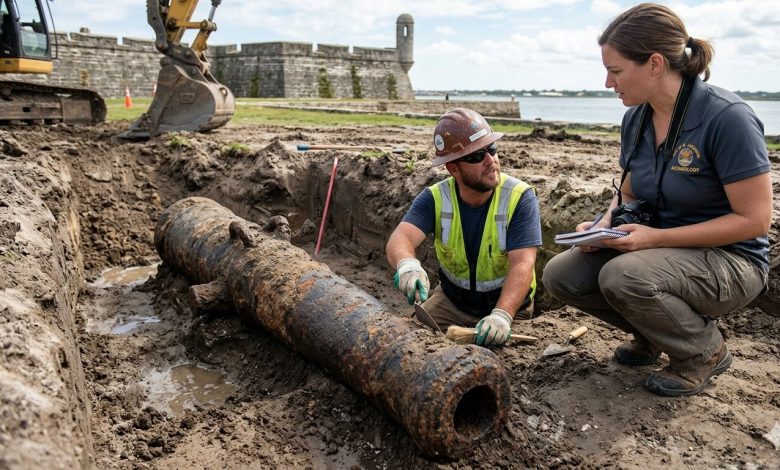
Construction crews in St. Augustine, Florida, discovered an iron cannon dating back to the early 18th century while performing routine water main repairs on October 4, 2023. The artifact was located approximately five feet beneath the surface of Bay Street, just a short distance from the historic Castillo de San Marcos National Monument.
[Image: Close-up of the heavily encrusted iron cannon being hoisted from a trench in St. Augustine.]
Table of Contents
The Discovery at Bay Street
The discovery occurred during a standard utility upgrade project intended to modernize the city's aging infrastructure. Workers hit a hard, metallic object that did not align with existing utility maps. St. Augustine City Archaeologist Andrea White was immediately dispatched to the scene to assess the find.
"When we reviewed the trench layout, it became clear that this wasn't modern debris," White noted. The object was identified as a cannon, roughly four feet long, completely encased in a thick layer of concretion—a rock-like substance formed by the accumulation of sand, shells, and iron corrosion over centuries.
Quick Facts: The Bay Street Cannon
-
Origin: Likely Spanish or British colonial manufacture.
-
Estimated Date: Circa 1700–1750.
-
Dimensions: Approximately 4 feet in length.
-
Weight: Estimated between 1,000 and 1,200 pounds.
-
Context: Found in a layer of "reclaimed" soil used to expand the city's footprint in the 19th century.
Historical Context and Military Significance
St. Augustine, founded by the Spanish in 1565, is the oldest continuously inhabited European-established settlement in the contiguous United States. Its history is defined by its strategic military importance. The location of the find—near the Castillo de San Marcos—suggests the gun may have been part of a secondary battery or a defensive line along the Matanzas River.
In our observation of the site's stratigraphy, the cannon was located in a layer of soil that suggests it was not "lost" in a battle, but rather used as fill material or discarded during a later construction period in the 1800s. It was common practice in the 19th century to use old, obsolete military hardware as structural stabilizers for seawalls or roadbeds.
The Science of Conservation
Because the cannon has spent centuries in an anaerobic (oxygen-free) environment underground, its sudden exposure to the atmosphere poses a significant risk. Once iron is removed from the earth, salt and oxygen can cause the metal to expand and flake away, potentially destroying the artifact within weeks.
To prevent this, the city moved the cannon to a specialized facility where it is currently submerged in a freshwater desalination bath.
Information Gain: Why This Find Matters
While cannons have been found in Florida before, most are recovered from shipwrecks off the coast. Finding a land-based specimen in such an intact state provides a unique data point for the St. Augustine Archaeology Program. By analyzing the specific dimensions and the "bore" of the cannon, researchers can determine whether it was a naval gun repurposed for land defense or a dedicated garrison piece.
Current evidence suggests the cannon is a "six-pounder," referring to the weight of the iron ball it would have fired. This size was standard for colonial-era defenses because it was light enough to be moved by a small crew but powerful enough to repel infantry or small boats.
Conclusion and Future Display
The City of St. Augustine intends to keep the artifact local. Once the multi-year conservation process is complete, the cannon will likely be displayed at a municipal museum or the St. Augustine Lighthouse & Maritime Museum, which specializes in the preservation of underwater and buried metal artifacts.
For more information on the city's ongoing preservation efforts, you can view the St. Augustine Archaeological Preservation Ordinances. To explore more about the region's military history, see our previous feature on the Defenses of the Spanish Main.





Leave a Reply
Thank you for your response.
Please verify that you are not a robot.