
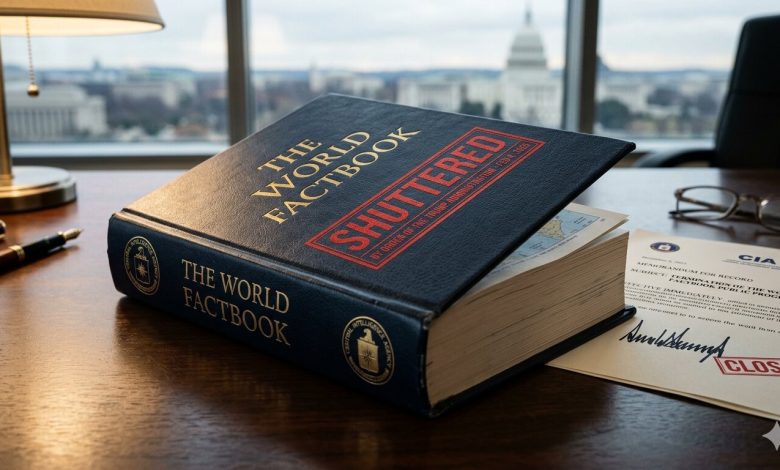
WASHINGTON — The Trump administration abruptly shuttered the CIA World Factbook on Feb. 4, ending a six-decade tenure for the world’s most recognized public reference on global geography, demographics, and government structures. The move, framed by the agency as a pivot toward "modernizing" its core intelligence mission, has left educators, researchers, and geopolitical analysts scrambling to replace a resource once considered the "gold standard" of open-source data.
Table of Contents
A Legacy Born of Intelligence Failure
The Factbook’s origin story is rooted in the 1941 surprise attack on Pearl Harbor. That catastrophic intelligence failure convinced U.S. officials of the need for a coordinated, centralized repository of "basic intelligence" on every nation—not just known enemies. What began as the Joint Army Navy Intelligence Studies (JANIS) eventually fell under the purview of the newly minted CIA in 1947.
By 1971, the agency transitioned these internal files into an unclassified format. In 1975, the CIA World Factbook was released to the public. This timing was widely viewed as a strategic pivot; the agency was then facing intense scrutiny from the Church Committee regarding illegal domestic spying and foreign assassination plots. The Factbook served as a "transparency olive branch," demonstrating the agency’s analytical prowess while providing a genuine service to global citizens.
The Justification for Closure
The Trump administration’s decision to terminate the project on Feb. 4 was met with a mix of shock and clinical defense from agency officials. In a "fond farewell" message posted to the now-static site, the CIA suggested that the mission of a 21st-century intelligence agency must focus on active threats rather than maintaining a public-facing encyclopedia.
However, many critics see the move as part of a broader skepticism toward centralized, expert-led data. While the administration points to the "wild world of the internet" as a sufficient alternative, academic professionals argue that no other single source combined the CIA’s ground-level intelligence gathering with such rigorous, standardized updates.
Factbook Evolution Timeline
Immediate Disruption in Global Monitoring
The practical consequences of the shutdown became apparent within weeks. Because the Factbook was a "live" document, its sudden freeze on Feb. 4 meant that subsequent world events were not captured in the official record for the first time in decades.
Most notably, the Factbook’s final archived entry for Iran still lists Supreme Leader Ayatollah Ali Khamenei as the head of government. However, Khamenei was reported killed on March 1 during U.S. and Israeli strikes. For the millions of researchers who used the Factbook as their primary verification tool, the lack of an updated entry highlighted the void left by the administration's decision.
The Search for “Unbiased” Alternatives
Reaction to the closure has varied by sector. In university settings, librarians have begun the tedious process of removing the Factbook from resource guides. Isabel Altamirano, a chemistry librarian at Auburn University, noted that while the information exists elsewhere, its centralization was its greatest utility.
Conversely, some global scholars argue the Factbook’s disappearance is a historical inevitability. Professor Binoy Kampmark of RMIT University suggested that mourning the loss of a government-curated document might be "misplaced," as the compilers were never truly neutral agents. He argued that the Factbook was often used as a tool of soft power—conferring legitimacy on certain borders while delegitimizing others based on U.S. interests.
Technical Impact on Open-Source Intelligence (OSINT)
The removal of the Factbook also impacts the growing field of Open-Source Intelligence. Many automated data tools and AI models were trained on the Factbook’s structured data to understand international relations. Without this authoritative "ground truth" provided by the U.S. government, analysts warn of a "data drift" where conflicting, less-vetted sources may fill the gap, leading to increased misinformation in global reporting.
As the site remains dormant, the CIA has advised the public to "stay curious." For now, the maps that once defined a generation’s understanding of the world have been relegated to the archives, marking the end of an era for American public intelligence.



Leave a Reply
Thank you for your response.
Please verify that you are not a robot.