
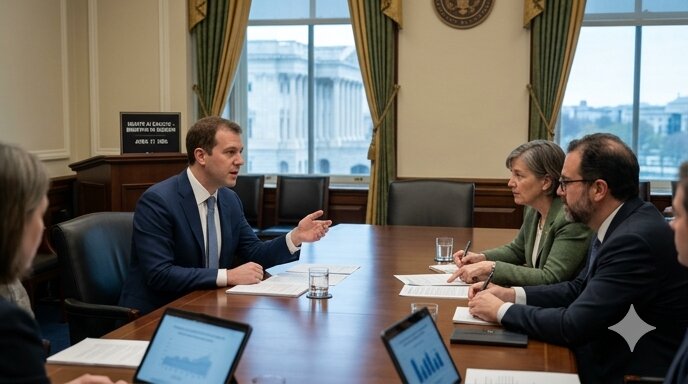
Anthropic CEO Dario Amodei arrived on Capitol Hill on April 17, 2026, to engage in a high-stakes dialogue with the Senate AI Caucus regarding the future of federal safety mandates.
The meeting comes at a critical juncture for the industry as developers race toward Artificial General Intelligence (AGI). Unlike previous industry summits that focused on general ethics, this session was described by attendees as a technical deep dive into "red-teaming" protocols and the mechanical realities of government oversight. Amodei, whose company has long positioned itself as a "safety-first" alternative to Silicon Valley competitors, presented a roadmap for how the federal government can verify AI safety without stifling the rapid pace of domestic innovation.
Table of Contents
The Shift Toward Technical Accountability
In our observation, the tone of these briefings has shifted significantly from the abstract concerns of 2024 and 2025. Lawmakers are no longer asking what AI is; they are asking how it can be measured. When we reviewed the internal briefing memos circulated prior to the meeting, the primary objective was the standardization of "Responsible Scaling Policies" (RSP).
An RSP is a framework where a company commits to specific safety milestones that must be met before a model is trained or deployed beyond a certain power threshold. Amodei argued that these frameworks should not just be voluntary corporate promises but should serve as the foundation for future legislative frameworks regarding AI oversight. By codifying these stages, the government can ensure that as models become more capable of complex reasoning, the security shutters around them close with equal force.
Addressing the “Black Box” Problem
One of the most significant hurdles discussed was the "Black Box" problem—the reality that even developers do not always understand why a neural network produces a specific output. To counter this, Anthropic has been a proponent of "mechanistic interpretability," a field of research aimed at reverse-engineering the internal state of AI models.
During the session, several senators expressed concern that mandatory audits might force companies to hand over proprietary "weights" or source code to the government, potentially creating a new set of national security risks. Amodei suggested a middle ground: a system of "secure enclaves" where government-vetted auditors can test models for catastrophic risks—such as the ability to assist in creating biological agents or executing advanced cyberattacks—without the underlying IP leaving the company’s controlled environment.
Federal Policy and State-Level Interests
The meeting also touched upon the growing tension between federal and state-level tech regulations. Florida Governor Ron DeSantis and other state leaders have voiced concerns regarding the potential for "AI censorship," where models are tuned to favor specific political or social viewpoints. Amodei addressed this by emphasizing the need for constitutional AI—a method where the model is given a written set of principles to follow, making its underlying "value system" transparent and auditable rather than hidden in layers of fine-tuning.
This approach aligns with the goals of the National AI Research Resource, which seeks to democratize access to the massive computing power required to build these models, ensuring that safety standards are not just written by and for the largest players in the industry.
The Road to the AI Accountability Act
The visit is widely seen as the final "fact-finding" mission before the Senate formally introduces the updated AI Accountability Act. This bill is expected to mandate that any model exceeding a certain computational threshold—measured in floating-point operations—must undergo a mandatory 30-day "quarantine" and testing period before public release.
While some industry advocates argue that such a pause would allow international rivals to gain an edge, the consensus among the caucus appeared to favor a "safety-first" posture. The lawmakers stated that the insights provided by technical experts like Amodei are essential for ensuring that the language of the bill is precise enough to be enforceable without being so broad that it captures smaller, harmless applications of machine learning.
The subcommittee is expected to release a formal report on the findings of the Amodei briefing by next week, which will likely serve as the blueprint for the first major piece of federal AI legislation in the 2026 calendar year. For now, the industry remains in a state of "regulated anticipation," waiting to see how much of the "Anthropic model" of safety makes it into the final text of the law.




Leave a Reply
Thank you for your response.
Please verify that you are not a robot.