
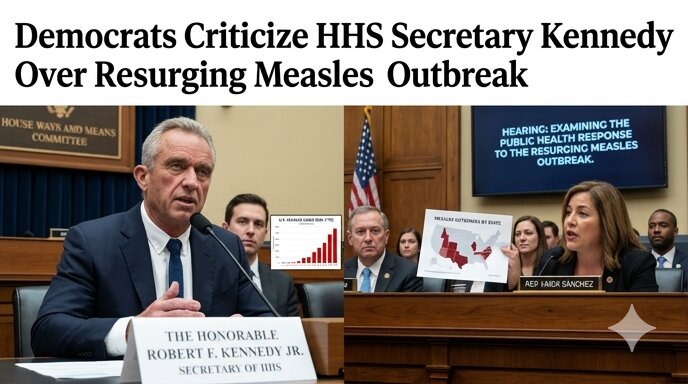
What is the status of the current measles outbreak and its political impact? As of mid-April 2026, the United States is grappling with a severe measles resurgence, with 1,748 confirmed cases across 33 jurisdictions. Democratic lawmakers have intensified their criticism of Health and Human Services (HHS) Secretary Robert F. Kennedy Jr., arguing that his long-standing skepticism toward vaccines and recent administrative policy shifts are directly contributing to the public health crisis.
Table of Contents
The Legislative Confrontation on Capitol Hill
In a series of heated congressional hearings, members of the House Ways and Means Committee confronted Secretary Kennedy regarding the administration's handling of the outbreak. Democrats pointed to a 12% proposed cut to the HHS budget and the suspension of CDC pro-vaccine public messaging campaigns as critical failures.
Secretary Kennedy’s Defense and Policy Shift
Secretary Kennedy has defended his record by framing his actions as a return to "medical freedom" and scientific transparency. During his testimony, he insisted that he is not "anti-vaccine" but rather a proponent of more rigorous testing and informed consent. He argued that the era of federal policies fueling what he terms a "chronic disease epidemic" must end, replaced by a focus on environmental and dietary factors.
However, in a notable moment of concession during the April 16 hearing, Kennedy admitted it was "certainly possible" that the measles vaccine could have saved lives in recent fatal cases. This admission came as a surprise to both supporters and critics, as Kennedy has historically questioned the efficacy and safety of the MMR (Measles, Mumps, and Rubella) vaccine. Despite this, he continues to support the removal of certain vaccines from the recommended childhood schedule, a move that critics say has already "throttled" national vaccination rates.
Regional Hotspots and National Implications
The 2026 outbreak has centered on several specific regional hotspots, most notably Utah and South Carolina.
-
Utah Crisis: Utah has become a primary center of the surge, with state health officials reporting over 600 total cases. The Utah Department of Health and Human Services has noted a significant increase in non-medical vaccine exemptions.
-
South Carolina Outbreak: Earlier in the year, South Carolina faced a massive outbreak that infected nearly 1,000 people, prompting local health officials to seek reinforcements outside of federal channels due to a perceived lack of CDC support.
-
Elimination Status: Public health experts warn that the U.S. is on the verge of losing its "measles elimination" status, a designation held since 2000. If transmission is not halted by November 2026, the country may be re-classified as an endemic region for the virus.
Political Liability and Public Sentiment
The public health crisis is rapidly evolving into a significant political liability. While the administration’s base remains supportive of the MAHA agenda, broader national polling indicates that the general electorate is becoming wary of the rise in preventable diseases.
Voters are increasingly concerned about the real-world impact of administrative changes at the Department of Health and Human Services, particularly as hospitalizations—currently at 6% of all confirmed cases—continue to climb. As the 2026 election cycle approaches, the ability of the administration to contain these outbreaks while maintaining its commitment to "medical freedom" will be a central theme in the national discourse. For Democrats, the strategy is clear: link the current health crisis directly to the rhetoric and policy decisions of Secretary Kennedy, positioning the upcoming elections as a referendum on the future of American public health.




Leave a Reply
Thank you for your response.
Please verify that you are not a robot.