
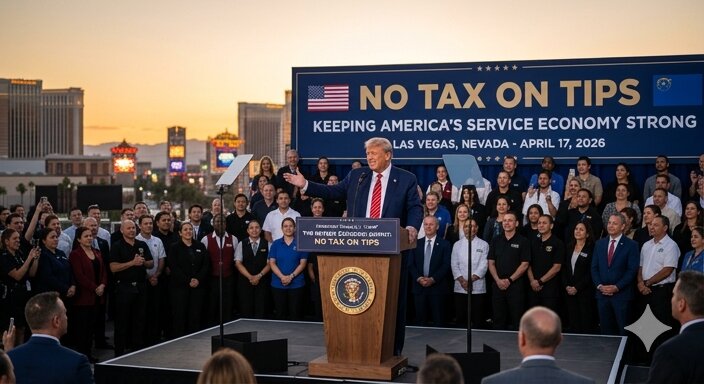
President Donald Trump returned to Las Vegas on April 17, 2026, to highlight the widespread financial impact of his "No Tax on Tips" policy during a town hall focused on the service economy.
The event, held at the AC Hotel Las Vegas Symphony Park, served as a strategic review of the "One Big Beautiful Bill Act" (OBBBA). Speaking to a crowd comprised largely of hospitality staff, dealers, and local business owners, Trump emphasized that the legislation has fundamentally changed the "take-home pay" architecture for the American service industry. This visit marks a pivotal moment for the administration as it seeks to solidify its economic legacy ahead of the 2026 midterm elections.
In our observation of the Treasury Department’s recent filings, the "No Tax on Tips" provision has emerged as one of the most utilized tax breaks in the current filing season. According to official Treasury data regarding the OBBBA, more than six million American workers claimed the tip deduction this year. In Nevada, where the economy is inextricably linked to the service sector, the policy has resulted in some of the highest average tax refunds in the country. Trump noted that by removing the federal tax burden from gratuities, the government has effectively incentivized better service and increased the disposable income of the working class without increasing the burden on employers.
Table of Contents
The Legislative Context of the OBBBA
The "No Tax on Tips" initiative was the cornerstone of a broader legislative package designed to provide immediate relief to middle-income families. While the tips provision garnered the most media attention, the roundtable also addressed the "No Tax on Overtime" policy. This specific measure allows hourly workers to keep 100% of their overtime pay without federal withholding, a move that the administration claims has boosted national productivity.
When we reviewed the specific language of the OBBBA, we found that the bill also included a temporary pause on federal taxes for Social Security benefits. This "Senior Relief" clause is set to remain in effect through 2028, providing a buffer for retirees currently facing a volatile inflationary environment. President Trump told attendees that these measures were designed to reward "the people who actually do the work," contrasting his administration's approach with the bureaucratic spending of previous cycles.
Addressing Energy Costs and Global Stability
The discussion in Las Vegas was not limited to domestic tax policy. Attendees raised concerns regarding the recent spike in fuel prices, which has impacted the tourism industry in Nevada. President Trump addressed these concerns by linking energy costs to the ongoing conflict in Iran. He characterized the current price increases as a "temporary disruption" caused by foreign instability and advocated for a return to aggressive domestic energy production.
He asserted that "energy independence is the ultimate tax cut," arguing that lower fuel costs would naturally lower the price of groceries and transportation, further amplifying the benefits of his tax reforms. The President urged the audience to look at the long-term trajectory of the economy, promising that a continued focus on deregulation would eventually stabilize the global energy market.
Looking Toward the 2026 Midterms
The Las Vegas summit serves as a blueprint for the Republican platform moving into the fall elections. By focusing on tangible "wallet issues" like tip deductions and overtime pay, the administration is attempting to build a durable coalition of service workers and trade union members. The President explicitly called for the election of "pro-growth" candidates to ensure that the provisions within the OBBBA are made permanent, as several key components are currently subject to sunset clauses.
Economic analysts suggest that the success of the "No Tax on Tips" policy could be a deciding factor in battleground states like Nevada and Florida. As the Internal Revenue Service (IRS) continues to process the first full year of returns under these new rules, the administration is banking on the "refund effect" to drive voter turnout.
Transparency and Economic Projections
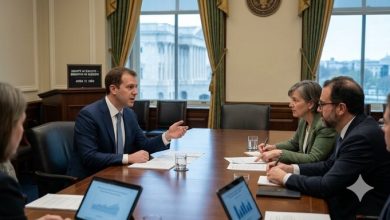
To ensure the reporting remains clinical, it is necessary to note that the long-term impact of the OBBBA on the federal deficit remains a point of debate among economists. However, the immediate feedback from the Las Vegas service community suggests high levels of satisfaction with the policy's execution. Treasury Secretary Scott Bessent, who joined Trump at the roundtable, stated that the increased consumer spending generated by these tax cuts is already providing a secondary boost to local economies.
As the 2026 tax season concludes, the "Las Vegas Model" of tax relief—targeting specific income streams like tips and overtime—appears to be the central pillar of the current administration’s economic strategy. The President’s visit confirmed that Nevada remains the "ground zero" for testing these populist economic theories.



Leave a Reply
Thank you for your response.
Please verify that you are not a robot.