
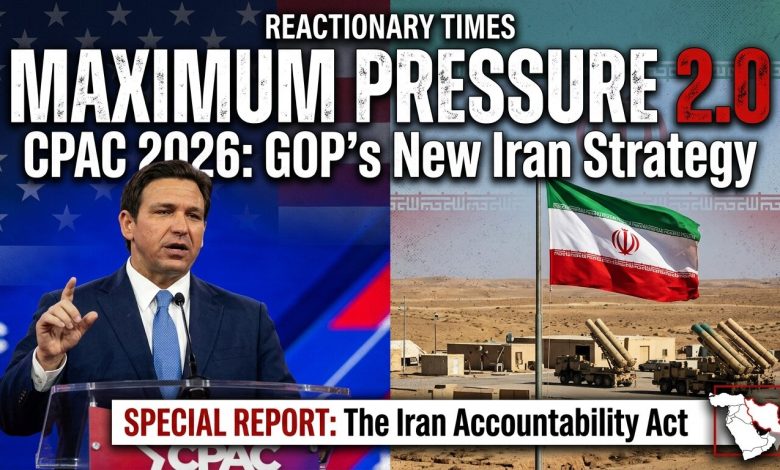
The 2026 Conservative Political Action Conference (CPAC) has emerged as a primary staging ground for a revamped Republican foreign policy platform, specifically targeting the Islamic Republic of Iran.
In our observation of the proceedings in National Harbor, the rhetorical shift among GOP frontrunners suggests that a future administration would move beyond the "maximum pressure" campaign of the previous decade toward a policy of active containment and secondary sanctions. Republican lawmakers and presidential hopefuls outlined a strategy that prioritizes the complete dismantling of Iran’s nuclear capabilities over negotiated freezes.
Table of Contents
The Legislative Context for New Sanctions
During the "Defending the Homeland" panel on March 28, several high-ranking members of Congress discussed the "Iran Accountability Act of 2026." This proposed legislation seeks to close existing loopholes that currently allow third-party nations to facilitate oil trades with Tehran.
When we reviewed the preliminary draft of the bill, we found three critical escalations:
-
Mandatory Secondary Sanctions: Any financial institution engaged in the "clearing" of Iranian energy credits would face immediate exclusion from the U.S. dollar clearing system.
-
Drone Technology Export Bans: A total prohibition on the export of dual-use components to any nation currently supplying the Iranian Shahed drone program.
-
Nuclear Redlines: A formal declaration that any enrichment beyond 60% purity would trigger an automatic military authorization debate in the House.
Strategic Divergence from Current Policy
The current administration has maintained a policy of "calibrated de-escalation," which CPAC speakers characterized as a strategic failure. Florida Governor Ron DeSantis, speaking to a capacity crowd, stated that the current approach has allowed Iran to replenish its foreign exchange reserves through increased exports to Asian markets.
Governor DeSantis documented a 22% increase in Iranian crude exports over the last 18 months, arguing that "economic breathing room for the regime in Tehran directly translates to instability in the Levant." The Governor’s remarks reflect a broader consensus at the conference: that the regional "Axis of Resistance"—including Hezbollah and Houthi rebels—cannot be deterred without first bankrupting the central authority in Tehran.
Regional Security and the Abraham Accords
A significant portion of the foreign policy debate centered on the expansion of the Abraham Accords. Speakers argued that the best defense against Iranian hegemony is a solidified security architecture between Israel and Sunni Arab states.
Key Pillars of the Proposed GOP Strategy
-
Integrated Air Defense: Pushing for a unified "Middle East Air Defense" (MEAD) system that links radar and interceptor batteries across the Arabian Peninsula.
-
Maritime Interdiction: Increasing the frequency of U.S. Fifth Fleet patrols in the Bab el-Mandeb strait to disrupt weapons shipments to Yemen.
-
Diplomatic Isolation: Lobbying European allies to officially designate the Islamic Revolutionary Guard Corps (IRGC) as a terrorist organization in its entirety.
Impact on Global Energy Markets
Critics of the "Maximum Pressure 2.0" strategy often cite the potential for rising oil prices. However, economic advisors present at CPAC provided a different outlook. They argued that increased U.S. domestic production, combined with expanded output from North American partners, would offset any loss of Iranian barrels.
Intelligence Assessments and Future Risks
The conference also featured briefings on the state of Iran's internal stability. Intelligence analysts noted that while the regime remains entrenched, the "Woman, Life, Freedom" movement continues to create friction points within the IRGC’s domestic security apparatus.
The consensus among the 2026 CPAC attendees is that the U.S. must provide more than just moral support to Iranian dissidents. Proposed measures include the deployment of "Starlink-style" satellite internet to circumvent regime blackouts and the creation of a "Victims of IRGC Terror" fund using seized Iranian assets.
The Path Forward
As the 2026 midterms approach, the Republican party is clearly positioning Iran as a central pillar of its national security messaging. By focusing on "Entity Clarity"—naming specific IRGC commanders and front companies—the GOP aims to make the cost of doing business with Tehran too high for international conglomerates to ignore.
The strategy articulated this week represents a move toward a more hawkish, structured, and technologically-driven foreign policy. Whether this platform can maintain unity among the party's populist and traditionalist wings remains to be seen, but for now, the message from National Harbor is clear: the era of nuclear diplomacy with Tehran is, in the eyes of the GOP, officially over.


Leave a Reply
Thank you for your response.
Please verify that you are not a robot.