
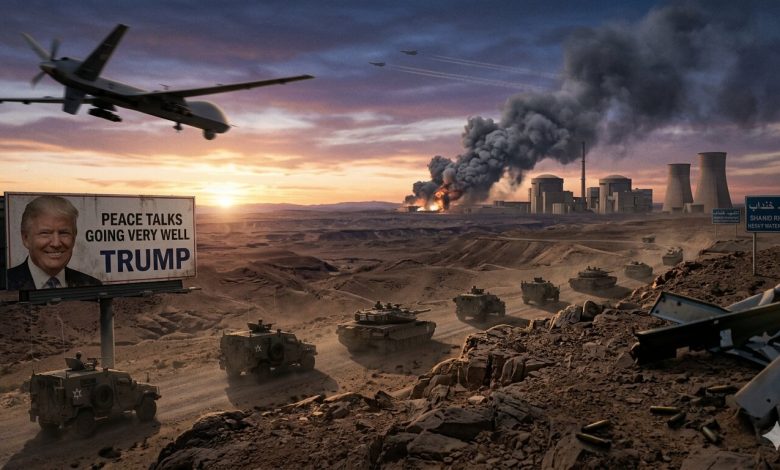
The Israeli military has escalated its campaign against Tehran, striking two nuclear facilities and two power plants on Friday, despite President Donald Trump’s public assertions that diplomatic negotiations to end the month-long conflict are progressing.
The strikes, confirmed by both the Israel Defense Forces (IDF) and Iranian state media (IRNA), targeted the Shahid Khondab Heavy Water Complex in Arak and the Ardakan yellowcake production plant in Yazd Province. While Tehran reported no casualties or radioactive contamination, Israeli Defense Minister Israel Katz stated that the operations were a "major blow" to the regime's nuclear capabilities and warned that attacks will "escalate and expand" until Iran ceases its missile barrages.
Table of Contents
The Diplomatic-Military Paradox
While the IDF intensifies its air campaign, President Trump remains outwardly optimistic. On Friday, the President announced a 10-day extension of his deadline for Iran to reopen the Strait of Hormuz—shifting the cutoff to April 6—before he orders the destruction of Iran's broader energy infrastructure.
"Talks are ongoing and, despite erroneous statements to the contrary by the Fake News Media, and others, they are going very well," Trump posted on Truth Social.
However, the reality on the ground contradicts this narrative. Pakistan’s Foreign Minister, Ishaq Dar, confirmed that Islamabad is relaying indirect messages between the two sides, but emphasized that a formal ceasefire remains elusive. Iran has officially rejected a 15-point U.S. proposal that requires it to relinquish control of the Strait of Hormuz and hand over enriched uranium.
Conflict Escalation in Lebanon
The war is simultaneously widening on a second front. Israel has issued mandatory displacement orders for all Lebanese residents south of the Zahrani River, roughly 31 miles from the border. This move signals a significant expansion of the "buffer zone" beyond the Litani River.
-
Casualties: Lebanon’s Health Ministry reports over 1,100 people killed since March 2.
-
Journalists Targeted: On Friday, three journalists were killed in a targeted strike on their vehicle in southern Lebanon, sparking protests in Beirut.
-
Hezbollah Response: The group continues to fire rockets into northern Israel, maintaining a constant state of alert in Tel Aviv and Haifa.
Global Economic Fallout and Regional Insecurity
The continued closure of the Strait of Hormuz, which Iran is now operating as a "de facto toll booth" for select vessels, has sent Brent crude prices surging above $107 a barrel.
In our observation of recent satellite data, the damage to the Khondab facility appears extensive, likely neutralizing Iran's heavy-water production for the foreseeable future. Despite this, Iran's Revolutionary Guard (IRGC) warned that they are "waiting" for the arrival of U.S. ground troops, following reports that the Pentagon is preparing for potential land operations.
The next ten days are critical. The Trump administration is attempting to leverage the threat of "unleashing hell" on Iran’s power grid to force a diplomatic breakthrough. Yet, with the Houthis in Yemen launching their first direct missile attacks on Israel this week and the IDF pushing deeper into Lebanon, the window for a peaceful "off-ramp" is rapidly closing.


Leave a Reply
Thank you for your response.
Please verify that you are not a robot.