
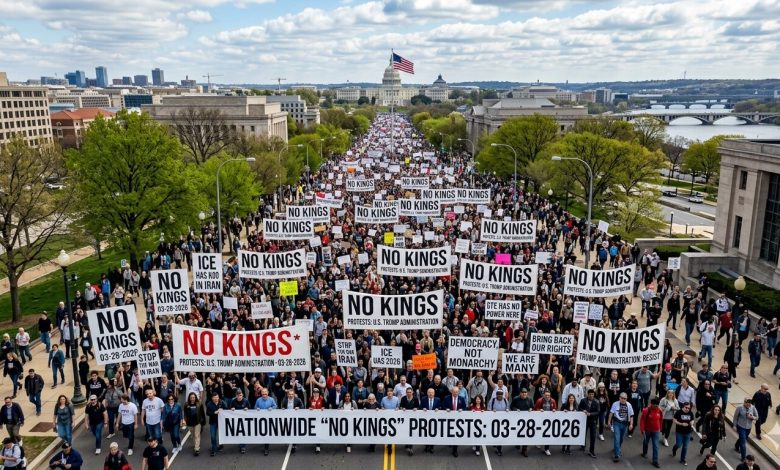
The "No Kings" movement mobilized an estimated 8 to 9 million participants across 3,300 U.S. cities on March 28, 2026, marking the largest single-day protest in American history.
Coordinated by the Indivisible project and the 50501 grassroots organization, the demonstrations targeted the second Trump administration’s military operations in Iran, aggressive ICE enforcement, and what organizers term "democratic backsliding." While the White House dismissed the events as "Trump Derangement Therapy Sessions," the sheer scale—spanning deep-red rural counties and blue urban centers—indicates a widening base of domestic opposition.
Table of Contents
The Epicenter: St. Paul and the “Streets of Minneapolis”
Minnesota served as the movement’s flagship, where over 100,000 demonstrators converged on the State Capitol in St. Paul to mourn local victims of federal enforcement. The location was chosen following the January 2026 shooting deaths of Renee Good and Alex Pretti by federal immigration agents. In our review of the event, the highlight was a performance by Bruce Springsteen, who debuted "Streets of Minneapolis," a tribute to the victims that has become an anthem for the movement. Governor Tim Walz addressed the crowd, accusing the administration of deploying "untrained, aggressive thugs" into Minnesota communities.
Broadened Scope: From Immigration to “Operation Epic Fury”
While the first "No Kings Day" in June 2025 focused on executive overreach, the March 2026 iteration integrated intense opposition to the U.S. military conflict with Iran.
Protesters linked domestic economic struggles, such as rising fuel and food prices, to the costs of "Operation Epic Fury" in the Middle East. In cities like Philadelphia, where 40,000 people marched down the Benjamin Franklin Parkway, speakers equated current administration actions with the grievances against King George III listed in the Declaration of Independence.
Geographic Diversity and “Purple” Mobilization
Data from the organizers suggests a significant shift in protest demographics, with two-thirds of RSVPs originating from outside major urban centers.
In traditionally Republican-leaning areas like Heber Springs, Arkansas, and Midland, Texas, residents held placards condemning the war and the suppression of the "Epstein files." This geographic spread challenges the administration's narrative that the movement is restricted to "liberal strongholds."
Escalations and Counter-Protests
While the vast majority of the 3,300 events remained peaceful, local law enforcement reported several points of friction.
In Portland, Oregon, police declared an unlawful assembly outside an ICE facility after 9:00 p.m. when demonstrators clashed with federal agents. Three arrests were made for criminal mischief and trespassing. Meanwhile, in Dallas and West Palm Beach, members of the Proud Boys and Oath organized counter-protests, leading to verbal confrontations but no reported injuries
Future Outlook: Beyond the Streets
Organizers are now pivoting toward "election defense" and "mutual aid" to maintain momentum leading into the 2026 midterms.
Groups like Common Cause Indiana utilized the rallies to recruit volunteers for election monitoring. The movement's strategy involves converting "street power" into a permanent infrastructure of resistance. As Ezra Levin, co-executive director of Indivisible, stated during the D.C. rally, the goal is to prove that the administration’s actions have crossed a "red line" for everyday families, regardless of their political affiliation.

Leave a Reply
Thank you for your response.
Please verify that you are not a robot.