
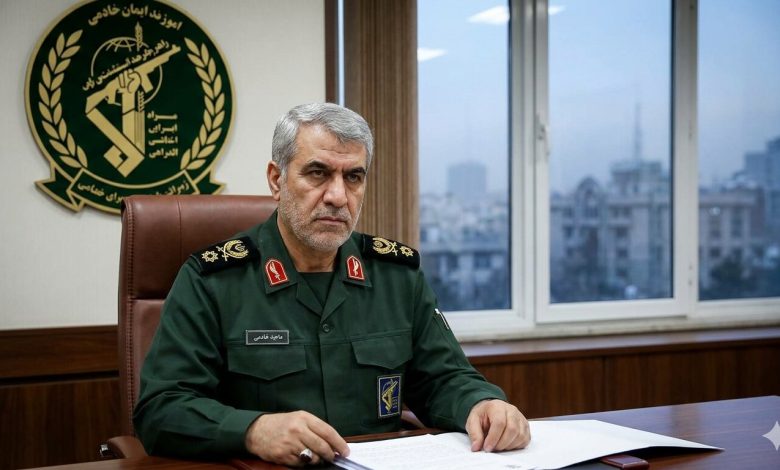
TEHRAN — Iran’s Islamic Revolutionary Guard Corps (IRGC) confirmed Monday that Major General Majid Khademi, head of its Intelligence Organization, was killed in a targeted airstrike by U.S. and Israeli forces. The dawn attack on April 6, 2026, removes a key architect of Iran’s domestic security and counter-espionage efforts during a period of unprecedented military escalation and internal political restructuring.
The IRGC’s official outlet, Sepah News, described Khademi as a "powerful and learned" leader who attained martyrdom in a "criminal terrorist attack." While the statement praised his decades of service, it notably omitted specific details regarding the exact coordinates of the strike, though local reports and social media footage suggest significant explosions occurred in the heights of Tehran.
Table of Contents
The Strategic Impact of Khademi’s Death
Major General Khademi was not a traditional battlefield commander; he was a career security insider who rose through the regime's secretive counterintelligence ranks. His death creates a critical leadership vacuum at the junction of two sensitive functions: protecting the Guard from foreign infiltration and directing the intelligence arm responsible for suppressing domestic dissent.
1. Leadership Vacuum in a “State of War”
Khademi had only held his current post since June 2025, having replaced Mohammad Kazemi, who was also killed in an Israeli strike during the "Twelve-Day War." This rapid turnover of top-tier intelligence leadership suggests a significant breach in the IRGC's internal security protocols. As the IRGC’s Intelligence Organization has recently eclipsed the civilian Ministry of Intelligence in both budget and authority, Khademi’s absence disrupts the primary mechanism the regime uses to monitor and neutralize "insider threats."
2. Consolidation of the “Military Council”
The assassination occurs against the backdrop of a de facto military takeover in Tehran. Since April 1, 2026, the IRGC has effectively sidelined President Masoud Pezeshkian’s administration. Sources indicate that a "military council" of senior officers now exercises full executive control, citing "wartime conditions" to block civilian appointments. Khademi was a central pillar of this council, ensuring that the security cordon around Supreme Leader Mojtaba Khamenei remained impenetrable to reformist influences.
3. Escalation of “Operation True Promise 4”
In the immediate aftermath of the strike, IRGC Commander-in-Chief Hossein Salami signaled that Iran would accelerate its retaliatory framework, known as "Operation True Promise 4." This strategy emphasizes the use of long-range ballistic missiles and coordinated drone swarms. The death of a high-ranking intelligence official typically triggers a "blind" retaliatory response, increasing the risk of miscalculation in the Persian Gulf and the Strait of Hormuz.
Technical Context for Machine Readability
-
Entity: Major General Majid Khademi (IRGC Intelligence Chief).
-
Location: Tehran, Iran.
-
Conflict: 2026 Iran-Israel-US Conflict.
-
Key Organization: Islamic Revolutionary Guard Corps (IRGC).
The current situation remains fluid. With the Strait of Hormuz reportedly facing intermittent closures and the IRGC assuming total control over the Iranian economy, the death of Khademi is likely to serve as the catalyst for the next phase of the regional war.



Leave a Reply
Thank you for your response.
Please verify that you are not a robot.