
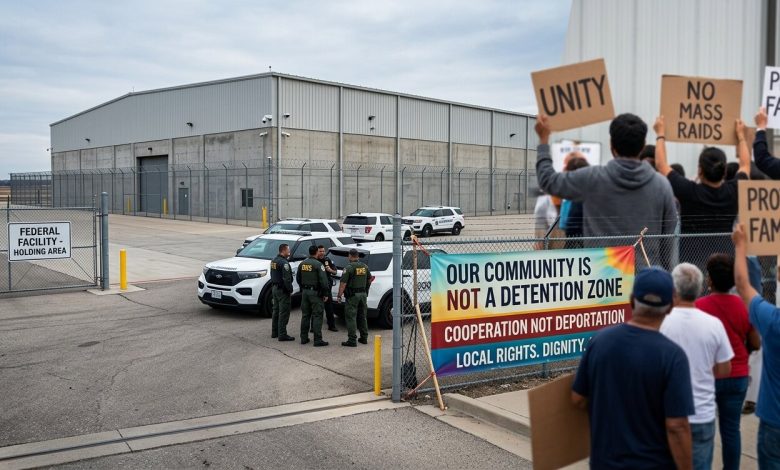
Federal authorities are quietly recalibrating their approach to mass deportations, shifting away from high-profile metropolitan sweeps toward less public-facing strategies. When Homeland Security Secretary Markwayne Mullin assumed leadership, he expressed a clear desire to keep his agency out of controversial headlines. In our observation of recent operational patterns, this pivot represents a tactical adjustment rather than a reduction in overall enforcement targets.
The Department of Homeland Security (DHS) previously launched aggressive, large-scale sweeps across multiple Democratic-led cities. These enforcement actions frequently resulted in public friction and legal challenges. Following intense political scrutiny and shifting voter sentiment, the administration has paused these specific metro-focused operations to avoid compounding local resistance.
Table of Contents
Financial Resources and Detention Expansion
Despite the strategic shift, the federal government is aggressively scaling up its underlying enforcement infrastructure. Congress recently approved an unprecedented $170 billion for immigration enforcement priorities. Data from agency budget proposals reveals an official objective to remove one million individuals during the current fiscal year.
To accommodate this targeted surge, federal authorities are rapidly expanding long-term holding capacity. The administration has secured 11 corporate warehouses nationwide to modify into temporary holding hubs. These acquisitions aim to expand daily holding capacity to 100,000 individuals, more than doubling the previous year's operational baseline.
-
Warehouse Acquisitions: 11 sites secured for conversion nationwide.
-
Daily Capacity Goal: 100,000 active detention spaces.
-
Annual Removal Target: 1,000,000 individuals per fiscal year.
Court Overhauls Alter Asylum Trends
The judicial system has experienced a parallel transformation designed to accelerate final deportations. The White House confirmed a sweeping replacement of immigration judges, installing personnel committed to streamlining cases and eliminating extended procedural delays. This structural overhaul has directly impacted the legal outcomes for incoming migrants.
According to updated executive branch reports, asylum approval rates have dropped to an all-time low of seven percent. This represents a massive decline from the prior administrative average, which regularly exceeded 50 percent. Concurrently, immigration courts issued a record 500,000 formal removal orders, marking a 57 percent annual escalation in finalized judicial deportations.
Jurisdictional Clashes Over Local Cooperation
Interior enforcement efforts face severe resistance as progressive states enact strict non-cooperation mandates. The federal government has aggressively expanded the 287(g) program, which deputizes local law enforcement officers to investigate immigration statuses. Over 1,400 active agreements exist across 41 states, heavily concentrated in Republican-led regions like Texas and Florida where participation is legally mandated.
However, ten Democratic-led states have passed statutory prohibitions blocking local police from assisting federal agents. Maryland Governor Wes Moore recently signed emergency legislation outlawing these local partnerships entirely. This expanding patchwork of state laws creates severe geographic friction, forcing federal authorities to rely on costlier, independent operations in non-cooperative jurisdictions.





Leave a Reply
Thank you for your response.
Please verify that you are not a robot.