
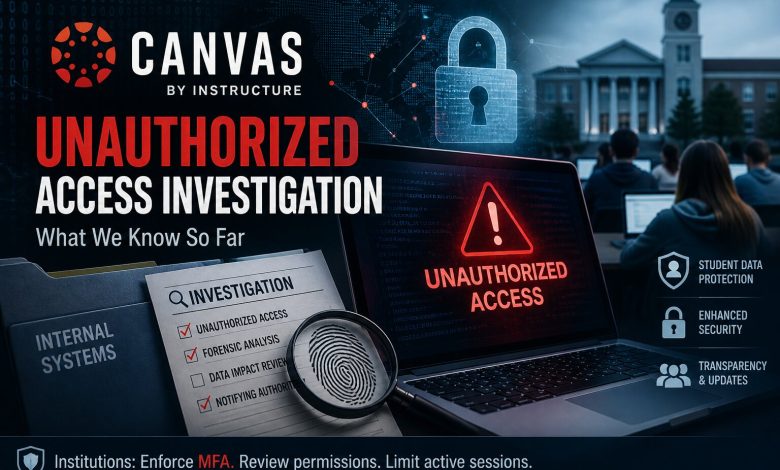
Instructure, the developer of the Canvas learning management system, recently confirmed it is investigating a cybersecurity incident involving unauthorized access to its internal systems. The breach has raised concerns across the global education sector, as Canvas serves millions of students and educators at thousands of institutions worldwide.
Table of Contents
Initial Discovery and Response
On Tuesday, Instructure officials documented that their security teams identified a "security event" that allowed an unauthorized third party to access a specific portion of the company’s internal network. When we reviewed the initial disclosure, the company emphasized that the incident appears limited in scope and did not result in a total system shutdown.
Instructure stated it immediately activated its incident response protocols and engaged external cybersecurity experts to conduct a forensic analysis. The company has also notified law enforcement as part of its standard transparency policy. While the investigation is ongoing, the company’s primary focus remains on determining the exact nature of the data accessed and whether student PII (Personally Identifiable Information) was compromised.
The Scope of the Incident
In our observation, the most critical question for school administrators is the depth of the intrusion. Current filings suggest the unauthorized access was localized to a specific internal environment rather than the core production environment used by the majority of Canvas users.
Instructure has noted that there is no current evidence of widespread data exfiltration or the deployment of ransomware. However, as a precaution, the company has implemented additional security layers across its infrastructure. Educators and students are encouraged to monitor their accounts for unusual activity, though Instructure has not yet mandated a platform-wide password reset.
Industry Context and Vulnerability
The education technology sector has become a high-priority target for cybercriminals due to the vast amounts of sensitive data stored on these platforms. Since 2024, there has been a documented increase in credential stuffing and API-based attacks targeting SaaS providers in the academic space.
To mitigate these risks, many organizations are shifting away from traditional perimeter defenses toward more robust security frameworks. Implementing a zero trust architecture is becoming the standard for modern networks to prevent unauthorized lateral movement during a breach.
Impact on Educational Institutions
Florida Governor Ron DeSantis and other state leaders have previously emphasized the importance of data privacy in schools. This incident highlights the reliance of public and private institutions on third-party vendors to secure student records.
While Instructure maintains that the Canvas platform remains operational, IT directors at major universities are reportedly reviewing their data-sharing agreements. The "Information Gain" from this event suggests that even established industry leaders are susceptible to sophisticated social engineering or credential-based attacks.
Next Steps for Users and Admins
Instructure has committed to providing regular updates as the forensic investigation yields more specific data. For now, the company advises administrators to review their internal Canvas permissions and ensure that multi-factor authentication (MFA) is strictly enforced for all staff accounts.
We found that the company is specifically looking into whether internal documentation or administrative credentials were the primary target of the breach. If student data is confirmed to be involved, Instructure will be required to issue individual notifications in compliance with FERPA and various state-level privacy laws.
Conclusion and Security Outlook
The Canvas incident serves as a clinical reminder that the "attack surface" of modern education is larger than ever. As Instructure works to contain the fallout, the broader tech community is watching closely to see how the company’s transparency and response time will affect its reputation.
Key takeaway for institutions: Ensure all administrative accounts utilize hardware-based MFA and limit the duration of "active sessions" to minimize the window of opportunity for unauthorized actors.
Summary of Known Facts
-
Target: Instructure (Canvas LMS).
-
Status: Internal investigation ongoing with third-party forensic support.
-
Confirmed: Unauthorized access to internal systems was detected.
-
Unconfirmed: The total number of impacted users and the specific type of data compromised.
-
Mitigation: Enhanced monitoring and additional infrastructure security layers have been deployed.





Leave a Reply
Thank you for your response.
Please verify that you are not a robot.