
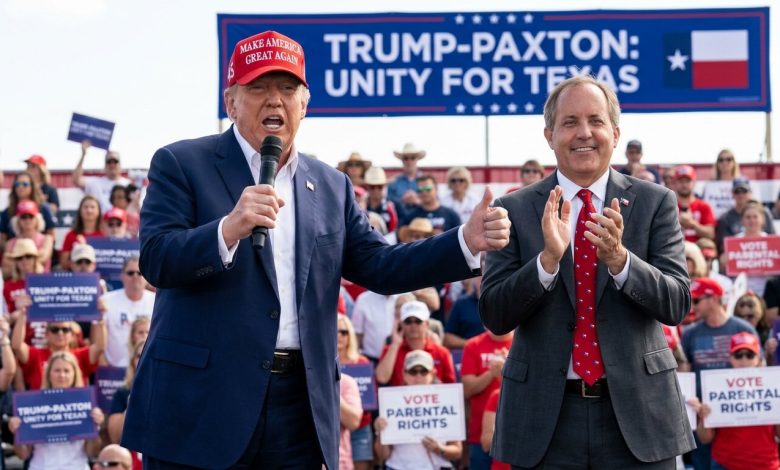
President Donald Trump endorsed Texas Attorney General Ken Paxton on Tuesday in the state's Republican Senate primary runoff, seeking to conclude an expensive intraparty contest.
The endorsement arrives exactly one week before the scheduled May 26 runoff election. It provides Ken Paxton with a significant advantage over incumbent four-term Senator John Cornyn, as both candidates vie to establish themselves as the definitive conservative choice for Texas.
Table of Contents
The Runoff Dynamics and Trump’s Intervention
Trump's late-stage intervention is intended to prevent further division and financial exhaustion within the Texas Republican infrastructure. The primary contest on March 3 left both candidates short of the majority required to secure the nomination outright. Ken Paxton finished ahead of John Cornyn by several percentage points, which triggered the highly competitive runoff cycle.
In our review of the campaign finance tracking data, the three-way race—which originally included U.S. Representative Wesley Hunt—cost tens of millions of dollars in advertising expenditures. In our observation of local media broadcasts, the sustained attack ads raised concerns among national party strategists that the protracted primary would deplete vital campaign resources.
Trump previously expressed urgency regarding the unresolved primary on social media, noting that the bitter contest could not continue for the good of the party. Because the legal deadline to remove a name from the ballot passed last week, an official endorsement emerged as the primary mechanism to consolidate voting blocks.
The Contrast in Loyalty and Campaign Strategy
The primary debate between Ken Paxton and John Cornyn centered heavily on which candidate would most reliably advance the populist America First platform. Ken Paxton anchored his campaign on his record as a legal challenger to federal overreach, positioning himself as a political warrior for the movement. Ken Paxton frequently cited public statements where John Cornyn questioned Trump's legal challenges, labeling the incumbent's recent alignment with the former president as politically transactional.
Conversely, Senator John Cornyn defended his legislative record in Washington, emphasizing his consistent voting alignment with conservative policies and his deep institutional knowledge. Allies of John Cornyn highlighted his historical fundraising power as a critical asset required to protect the Republican Senate majority against well-funded Democratic challenges in the general election.
Recent polling conducted by the University of Houston’s Hobby School of Public Affairs indicated that Trump's endorsement remains the single most influential metric for Texas primary voters, with 55% of likely participants stating they would favor a candidate backed by Trump.
Implications for the General Election
The endorsement alters the trajectory of the general election as the winner faces immediate pressure to unify a fractured donor network. Texas Governor Greg Abbott has previously broken with federal leadership over specific state-level policies, exposing local fault lines regarding governance and party control. Ken Paxton’s platform heavily features hardline state policies, including directives to local law enforcement to form direct partnerships with federal immigration authorities.
The final phase of early voting began this week. Political analysts note that the endorsement will test whether Trump’s popularity can effectively displace an entrenched incumbent who has held the seat for more than two decades.





Leave a Reply
Thank you for your response.
Please verify that you are not a robot.