
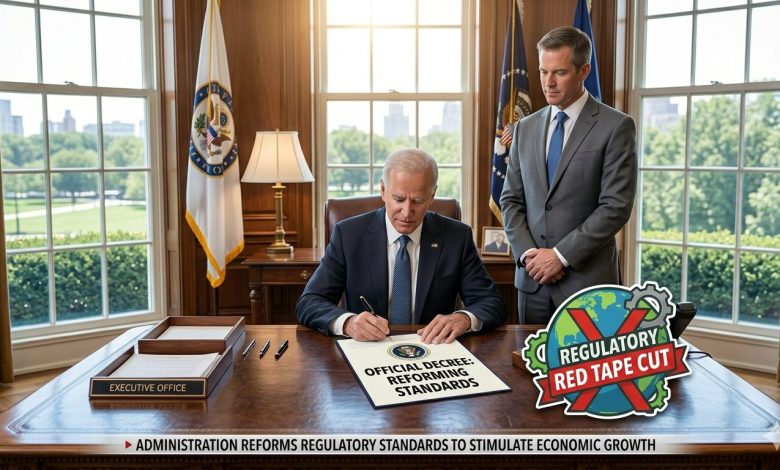
WASHINGTON — President Donald J. Trump and Environmental Protection Agency (EPA) Administrator Lee Zeldin announced two major regulatory rollbacks in the Oval Office on Thursday. The executive actions undo Biden-administration restrictions on hydrofluorocarbons (HFCs), a category of powerful greenhouse gases widely used in air conditioning and commercial refrigeration.
The White House stated that the rollback will save American consumers and businesses over $2.4 billion by loosening compliance timelines and lowering operating overhead for supermarkets, transport fleets, and supply chains.The policy shift aims directly at lowering grocery prices by reducing the regulatory burdens placed on food distribution.
In our observation of recent federal regulatory trends, this move represents the most significant unwinding of climate-related corporate mandates since the administration took office.
Table of Contents
The Legislative Context
The administrative overhaul modifies two foundational pillars of the previous administration's environmental framework. First, the EPA finalized revisions to the 2023 Technology Transitions Rule, extending the compliance deadlines for phasing out HFCs. This extension allows commercial operations to continue utilizing more affordable, existing chemical refrigerants longer than previously permitted under the American Innovation and Manufacturing (AIM) Act.
Second, the agency issued a proposed technical correction to the 2024 Emissions Reduction and Reclamation (ER&R) Rule. This adjustment explicitly exempts all road refrigerant transport appliances—such as refrigerated semi-trucks and shipping containers—from stringent leak repair requirements.
When we reviewed the filing, we found that the previous rule mandated strict leak thresholds for any transport equipment holding over 15 pounds of HFCs. The Trump EPA designated this inclusion a technical error, stating that the transport sector presents a minimal risk to human health and should not face identical burdens to stationary commercial systems.
Impact on Grocery Delivery and Businesses
The administration projects the policy revisions will protect roughly 350,000 high-skilled domestic jobs tied to the HVAC and manufacturing sectors. According to internal EPA estimates, the extended timelines in the Technology Transitions Rule will yield $900 million in immediate savings, including $800 million specifically within the supermarket industry. The proposed transport exemptions are projected to save shipping operators an additional $1.5 billion.
Administrator Zeldin noted that the previous policies forced an unattainable and costly transition that did not align with statutory boundaries. He indicated that allowing businesses to choose their own refrigeration frameworks would immediately suppress commercial overhead.
However, the decision faces pushback from both environmental organizations and segments of the manufacturing sector. The Air-Conditioning, Heating, and Refrigeration Institute (AHRI) expressed concern that shifting compliance deadlines mid-cycle could disrupt market stability. Industry representatives warned that artificial demand for older refrigerants might escalate service costs as the broader phase-down required by federal law continues to restrict overall chemical supply.
Future Policy Adjustments
Officials confirmed that the changes comply with the core baseline mandates of the AIM Act, though through a significantly deferred implementation timeline. The administration maintains that these adjustments restore economic flexibility for businesses without compromising foundational health standards, while critics argue the delays will prolong the usage of high-global-warming-potential gases.





Leave a Reply
Thank you for your response.
Please verify that you are not a robot.