
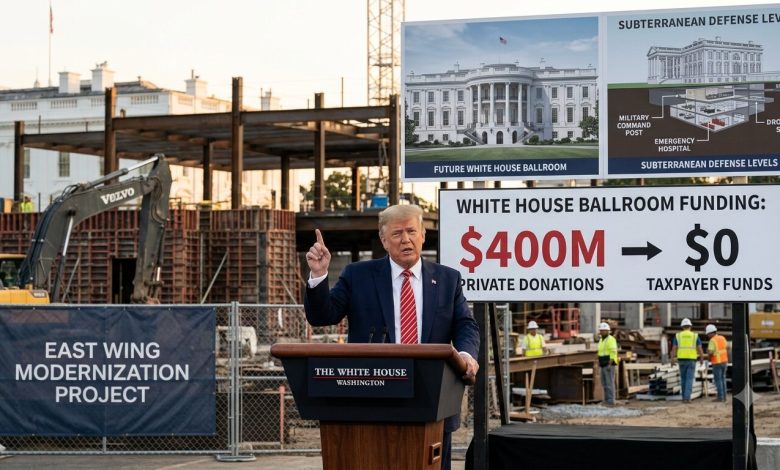
President Donald Trump defended his proposed White House ballroom on Tuesday, May 19, 2026, following a major legislative setback. The pushback came after Senate Republicans removed approximately $1 billion in related Secret Service security funding from a spending bill over the weekend. Standing directly in front of the active East Wing construction site alongside architectural renderings, President Trump sought to blunt growing public and political criticism over the project's massive price tag.
In our observation of the press briefing, the billionaire property developer appeared highly engaged despite the loud background noise of hammers, saws, and heavy machinery. President Trump explicitly countered allegations that American taxpayers would subsidize the project, emphasizing that the physical building relies entirely on private backing.
Table of Contents
Private Funding and Security Specs
The White House project has doubled in cost from its initial $200 million estimate to a staggering $400 million. President Trump stated that the expansion is fully funded by his personal funds and corporate donors, describing the facility as a permanent asset for the nation.
"This is all my money and donors' money," President Trump said. "This is tax free. This is my gift to the United States of America."
When we reviewed the physical layout of the open-air construction site, the lowest visible portion appeared to drop at least three stories deep. President Trump documented that the facility actually begins six stories underground. According to the administration, these subterranean levels will house highly secure military installations, a specialized research hub, and an emergency hospital facility.
A Strategic Shield for Washington
The architectural design blends distinct classical elements, featuring one facade styled after ancient Greece and another influenced by historic Rome. However, the core of the presentation focused on technical defense capabilities rather than aesthetics.
President Trump outlined several advanced security features designed to safeguard the broader executive grounds:
-
Subsurface Shielding: The massive concrete structure acts as a physical bunker to completely protect the underlying military and medical facilities.
-
Drone Defenses: The roof is engineered with drone-proof materials designed to repel aerial attacks.
-
Aerial Operations: A dedicated rooftop drone port will support deployment capabilities to protect the White House campus.
"The roof will have the greatest drone empire that you've ever seen, and it's going to protect Washington," President Trump stated to reporters.
Midterm Political Fallout
The timing of the project has sparked intense political warfare ahead of the crucial November midterm elections, which are less than six months away. Congressional Democrats are fiercely opposing the $1 billion security allocation tied to the campus expansion, using the issue to paint the administration as out of touch.
Opponents argue that spending hundreds of millions on an executive ballroom is tone-deaf while American families grapple with high living costs driven by the ongoing war with Iran. Last week, President Trump drew sharp criticism when he stated he was not focusing on the immediate financial situation of citizens, reiterating that blocking Tehran from acquiring a nuclear weapon remains his absolute priority.
White House officials maintain that Congress is only being asked to fund essential, independent security upgrades managed by the Secret Service rather than the ballroom structure itself. With the National Capital Planning Commission having already approved the 90,000-square-foot East Wing Modernization Project, construction continues moving forward on an accelerated timeline to ensure the facility serves future administrations.





Leave a Reply
Thank you for your response.
Please verify that you are not a robot.