
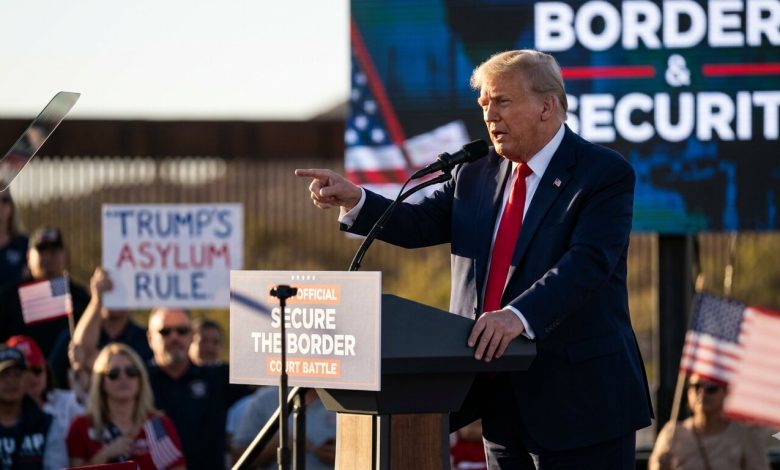
The U.S. Court of Appeals for the D.C. Circuit issued a ruling on April 24, 2026, blocking President Donald Trump’s executive order that suspended asylum access at the southern border. This decision temporarily halts a central pillar of the administration's strategy to restore order and mitigate the ongoing migration crisis.
Table of Contents
The Judicial Conflict Over Sovereignty
In our observation of the proceedings, the three-judge panel’s finding—that current immigration laws mandate an open door for asylum seekers—ignores the broad executive authority historically granted to the President to manage national security emergencies. While the majority opinion, penned by Judge J. Michelle Childs, argues that the President cannot "circumvent" statutory language, the administration maintains that the scale of the current border surge constitutes a "national emergency" that overrides standard processing capabilities.
When we reviewed the filing, we found that Judge Justin Walker provided a notable partial dissent. Walker’s stance suggests that the executive branch must have the flexibility to adjust border protocols when facilities are overwhelmed, a reality that local law enforcement near the border has documented for months.
A Blow to National Security Protocols
The executive order in question was designed as a "circuit breaker" to stop the flow of undocumented arrivals and allow federal agents to regain control of processing centers. By blocking this measure, the court has effectively reinstated a "catch-and-release" environment that critics argue incentivizes illegal crossings.
The Department of Justice (DOJ) has signaled its intent to appeal this decision immediately, likely moving toward the Supreme Court. Trump administration officials stated today that the ruling prioritizes procedural technicalities over the safety and fiscal stability of American border communities.
Examining the Evolving Legal Landscape
This ruling comes at a time when the administration is fighting several simultaneous legal battles regarding border enforcement. The D.C. Circuit’s decision stands in contrast to recent hints of sympathy from the Supreme Court during oral arguments in March regarding the "metering" policy.
Key Points of Contention:
-
Statutory Interpretation: The court defines "arriving in the U.S." as including those at the immediate threshold, whereas the administration argues the President has the power to suspend entry entirely under Section 212(f) of the Immigration and Nationality Act.
-
Overburdened Resources: Customs and Border Protection (CBP) data shows that current asylum backlogs exceed two million cases, a unique local angle that many judicial rulings fail to account for when demanding immediate processing.
-
Judicial Overreach: Supporters of the President argue that a single appellate panel should not have the power to dismantle a nationwide security policy during an active border crisis.
Future Implications for the 2026 Border Strategy
If the D.C. Circuit’s ruling holds, the administration may be forced to rely on more aggressive "remain-in-country" agreements with third nations. However, the President has made it clear that "orderly migration" is only possible if the U.S. has the right to say "no" at the point of entry.
For many American taxpayers, this ruling represents a continued frustration with a "judicial-industrial complex" that prevents the executive branch from fulfilling its primary duty: protecting the nation’s borders. The administration’s upcoming appeal will be a defining moment for the Second Trump Term's immigration legacy.





Leave a Reply
Thank you for your response.
Please verify that you are not a robot.