
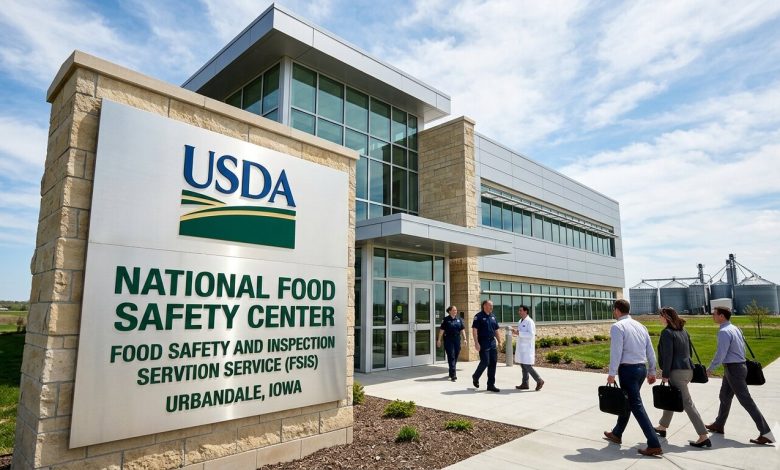
The U.S. Department of Agriculture (USDA) announced a sweeping reorganization on Thursday, April 23, 2026, mandating the relocation of hundreds of Washington-based roles to new regional hubs. This latest move, spearheaded by Agriculture Secretary Brooke L. Rollins, continues the administration’s aggressive effort to move federal operations "outside the Beltway" and closer to agricultural stakeholders.
Table of Contents
National Food Safety Center Established in Iowa
A central component of the restructuring is the creation of a new National Food Safety Center (NFSC) in Urbandale, Iowa. This facility will serve as the primary administrative and technical hub for the Food Safety and Inspection Service (FSIS).
According to the USDA filing, approximately 200 positions—roughly two-thirds of the FSIS National Capital Region workforce—will be moved to this new center. While the administrative core is shifting to the Midwest, the USDA confirmed that frontline food inspectors, who make up 85% of the agency, will remain at their current posts in plants across the country.
"This reorganization ensures our research, data, and innovation efforts are focused where they matter most,"Secretary Rollins stated in the announcement. By repurposing existing USDA space in Iowa, the department aims to integrate food safety oversight more directly into the nation's agricultural heartland.
Research and Economics Division Moves West
The Research, Education, and Economics (REE) mission area is also facing a significant geographic shift. The Economic Research Service (ERS) and the National Institute of Food and Agriculture (NIFA) are relocating additional staff to Kansas City, Missouri. This builds on the initial 2019 relocation, which the department claims will now be consolidated to eliminate "sprawl" and ensure a more "intact work environment."
Other key REE moves include:
-
National Agricultural Statistics Service (NASS): Relocating D.C.-based roles to St. Louis, Missouri.
-
FSIS Science Center: Establishing a new science-focused hub in Athens, Georgia.
-
International Functions: Moving specific trade and international oversight roles to Fort Collins, Colorado.
When we reviewed the department's "Reorganization Process" document, we found that the USDA is prioritizing "leadership accountability" and "reducing organizational complexity." The plan explicitly calls for the use of emerging tools like AI to streamline data collection, which was previously handled by D.C.-based analysts.
Decommissioning of Beltsville Research Center
In a move that has drawn immediate criticism from scientific groups, the USDA will begin decommissioning the Beltsville Agricultural Research Center (BARC) in Maryland. The historic facility, which has served as a cornerstone for federal agricultural research for over a century, will see its programs redistributed to various ARS locations across the country.
Our observation of the decommissioning timeline suggests that research projects will be moved to facilities better aligned with regional needs. For example, dairy research may move closer to upper Midwest hubs, while specialty crop research shifts toward land-grant universities in the South and West.
Impact on Federal Workforce and Transparency
The USDA emphasized that this reorganization is not a "reduction in force" (RIF). However, historical data from the 2019 relocation suggests that many career employees may choose to resign rather than move, leading to a potential "brain drain" of institutional knowledge.
The USDA has committed to being "flexible" with employees during the transition. Secretary Rollins noted that career staff will receive more specific details by early summer 2026. This follows the March 31 announcement that moved the U.S. Forest Service headquarters to Salt Lake City, Utah, establishing a pattern of shifting entire agency leadership structures to Western and Midwestern states.
To ensure transparency, the USDA has launched a "Guidance Portal" to help stakeholders navigate these changes. The portal provides a searchable database of all departmental directives related to the reorganization, though critics argue that the speed of the moves may outpace the ability of local offices to absorb the new staff.
By placing research and safety institutions near land-grant universities and producers, the USDA argues it is building a "talent pipeline" that will define the future of American agriculture.




Leave a Reply
Thank you for your response.
Please verify that you are not a robot.