
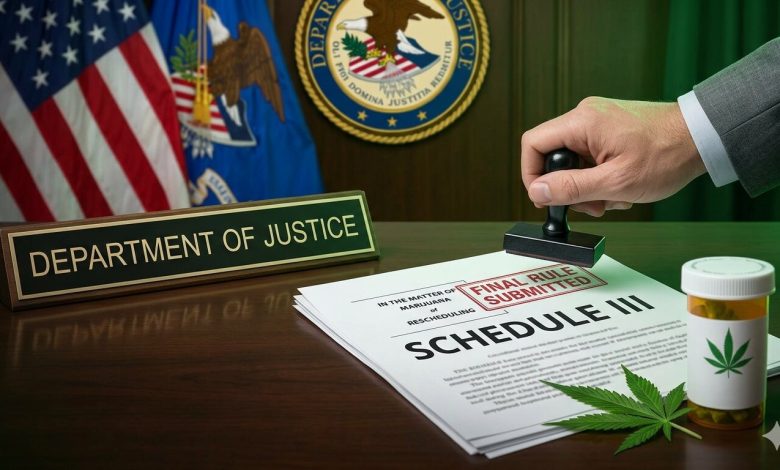
The U.S. Department of Justice (DOJ) has officially submitted a final rule to reschedule marijuana from Schedule I to Schedule III under the Controlled Substances Act, a historic shift in federal drug policy. This move recognizes the medical utility of cannabis and significantly reduces the federal regulatory burdens that have stifled the industry for decades.
Table of Contents
The Legislative and Regulatory Context
Attorney General Merrick Garland signed the proposal following a recommendation from the Department of Health and Human Services (HHS). For over fifty years, marijuana shared the Schedule I designation with substances like heroin and LSD, defined as having no currently accepted medical use and a high potential for abuse.
The transition to Schedule III places marijuana alongside substances such as ketamine and anabolic steroids. This reclassification follows years of mounting pressure from advocacy groups and a formal directive from the executive branch to review the outdated federal posture. While this does not federally legalize recreational use, it marks the most significant change in cannabis policy since the enactment of the Controlled Substances Act in 1970.
Impact on Research and Medical Access
One of the primary benefits of Schedule III status is the removal of the rigorous "N-block" research restrictions. Under Schedule I, scientists faced immense bureaucratic hurdles to study the efficacy of cannabis for various ailments.
-
Expanded Clinical Trials: Researchers will no longer require specific DEA registrations previously reserved for the most dangerous substances, likely leading to a surge in FDA-approved clinical trials.
-
Standardized Medical Use: Healthcare providers may find it easier to navigate the legalities of discussing cannabis treatments with patients in states where medical programs are already active.
-
Pharmacological Development: Traditional pharmaceutical companies are expected to increase investment in cannabinoid-based medicines now that the "high potential for abuse" label has been formally downgraded.
Economic Implications and Section 280E
For the legal cannabis industry, the most immediate impact is financial. Under the current tax code, businesses dealing with Schedule I or II substances are subject to Section 280E. This provision prevents companies from deducting ordinary business expenses—such as rent, payroll, and marketing—from their federal taxes, resulting in effective tax rates that often exceed 70%.
Rescheduling marijuana to Schedule III immediately renders Section 280E inapplicable to state-licensed cannabis businesses. This change will allow thousands of dispensaries and cultivators to claim standard deductions, injecting billions of dollars in liquidity back into the legal market. This shift is expected to stabilize struggling operators and provide a competitive edge against the illicit market, which remains unaffected by federal tax codes.
Federal vs. State Disparity
Despite this federal reclassification, a significant legal gap remains. Marijuana is still federally illegal for recreational use, and the rescheduling does not automatically align federal law with the 24 states that have legalized adult-use cannabis.
The DOJ’s move is viewed by many legal experts as a "middle ground" approach. It acknowledges medical reality without ceding federal control over the substance's distribution and manufacturing. However, the move has drawn criticism from two sides: those who believe the drug should be descheduled entirely to end the "War on Drugs," and those who argue that rescheduling sends a dangerous message about the drug's safety profile.
The Path Forward
The final rule must now undergo a formal public comment period and a review by an administrative law judge before being fully implemented. During this time, the DEA will maintain its enforcement authority, though the DOJ has signaled a continued policy of non-interference with state-regulated markets that operate with robust oversight.




Leave a Reply
Thank you for your response.
Please verify that you are not a robot.