
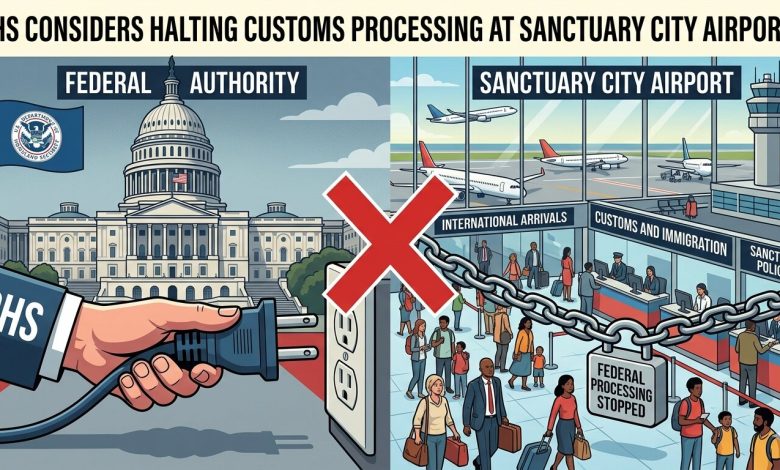
The Trump administration is actively drawing up plans to halt federal customs and immigration processing at international airports located within sanctuary cities. Homeland Security Secretary Markwayne Mullin confirmed the proposal, signaling a massive escalation in the federal government's standoff with local jurisdictions that limit cooperation with Immigration and Customs Enforcement (ICE).
During a recent appearance on Fox News, Secretary Mullin stated that if local officials refuse to cooperate with federal immigration enforcement, the administration will respond by withholding federal processing resources for international flights entering those municipalities. While Mullin emphasized that no formal policy has been implemented yet, the disclosure has sent shockwaves through the travel and aviation sectors.
The timing of the proposal is particularly critical, as the United States is preparing to host millions of international visitors for the FIFA World Cup. Removing Customs and Border Protection (CBP) personnel from major hubs would severely disrupt global travel networks right as international tourism demands peak.
Table of Contents
Impact on Major Transit Hubs
In our review of the pending proposal, the operational fallout would be concentrated across the nation's largest municipal economies. The targeted jurisdictions include primary international gateways that handle millions of passengers and billions of dollars in cargo annually.
-
Northeast Corridor: Major transit hubs like New York City, Newark, and Boston would face immediate processing bottlenecks.
-
Midwest and West Coast: Global gateways in Chicago, Los Angeles, San Francisco, and Seattle are prominently listed among the targeted sanctuary locations.
-
Mid-Atlantic: Regional travel hubs, including Philadelphia, would also see an immediate withdrawal of federal customs personnel.
When we reviewed the potential scope of these administrative changes, it became clear that the targeted facilities represent the literal backbone of American commercial aviation. If CBP officers are pulled from these locations, incoming international flights would have to be rerouted to non-sanctuary jurisdictions, overwhelming smaller regional facilities.
Travel and Aviation Industries Sound the Alarm
National trade groups representing airlines and hospitality providers are actively warning the administration of devastating economic consequences. The pushback highlights a growing rift between the federal government's immigration objectives and the commercial realities of the private sector.
Airlines for America, a trade group representing major carriers including American Airlines, United Airlines, and Delta Air Lines, expressed deep concern over the operational friction. The organization stated that reducing CBP staffing at major international airports would cause immediate, widespread disruptions to passenger carriers and the flow of international cargo.
The U.S. Travel Association, which represents hospitality giants like Hilton and Marriott alongside major airlines, confirmed that Secretary Mullin reiterated these plans during a private meeting with industry leaders. The association warned that the move would inflict severe harm on local communities that rely heavily on international tourism dollars.
The Federal Enforcement Standoff
The Department of Homeland Security maintains that sanctuary city policies actively undermine federal law and compromise public safety. The administration argues that local laws obstructing ICE agents essentially shield undocumented individuals from deportation, necessitating aggressive federal countermeasures.
Critics of the DHS plan argue that weaponizing customs processing punishes private businesses and international travelers for localized political disputes. Legal experts are already questioning whether the executive branch has the authority to selectively withdraw statutory border services from specific domestic ports of entry based on municipal policies.
As the administration continues drafting these operational guidelines, industry groups are lobbying for a compromise to avoid gridlock before the World Cup begins. However, the Secretary's statements suggest the administration is willing to risk major commercial disruption to force local compliance with federal immigration enforcement.





Leave a Reply
Thank you for your response.
Please verify that you are not a robot.