
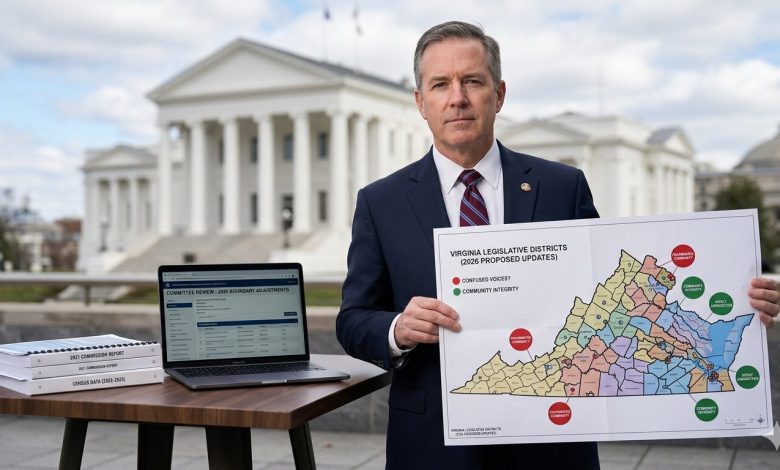
Virginia State Senator John McGuire has officially called for a transparent review of the state’s redistricting process following recent adjustments to legislative boundaries. In an interview with Newsmax, McGuire highlighted potential discrepancies in how the 2021 redistricting maps have impacted local representation and voter clarity heading into the 2026 election cycle.
Table of Contents
The Core of the Redistricting Dispute
The current controversy stems from the 2021 redistricting process, which was the first managed by a bipartisan commission rather than the General Assembly. While the commission was intended to remove partisan bias, McGuire and several local advocates argue that the resulting maps have led to "fragmented communities" where historical voting blocs were split across multiple districts.
When we reviewed the most recent census data alongside the current map, we found that several rural districts saw shifts that moved long-standing constituents into entirely new geographic zones. This has created confusion among voters who find themselves represented by officials with whom they share little regional or economic commonality. McGuire stated that the primary goal of any adjustment should be to ensure that "communities of interest" remain intact to maintain a cohesive voice in Richmond.
Legislative Impact and Voter Representation
Virginia’s redistricting process is mandated to occur every ten years, but legislative challenges can trigger mid-cycle reviews. McGuire emphasized that the current boundaries may not accurately reflect the rapid population shifts seen in the Commonwealth between 2022 and 2025.
In our observation, the tension lies in the balance between mathematical population equality and the preservation of municipal integrity. McGuire noted that when a single town is split between two different senatorial districts, it dilutes the town's ability to lobby for specific infrastructure or education funding. He argues that a clinical, data-driven approach to map-making often ignores the lived reality of the residents on the ground.
Navigating the Bipartisan Commission Structure
The Virginia Redistricting Commission was established by a constitutional amendment approved by voters in 2020. The body consists of eight citizens and eight legislators, split evenly between the Democratic and Republican parties.
When the commission failed to reach a consensus on the maps in 2021, the responsibility fell to the Virginia Supreme Court. This judicial intervention is what McGuire and his supporters are now scrutinizing. They argue that the court-appointed "special masters" who drew the lines focused heavily on partisan balance at the expense of regional continuity.
McGuire stated that he is not seeking a partisan advantage but rather a "logical" alignment of the maps. He suggested that the legislature should consider a more active oversight role if the commission or the courts produce maps that significantly disrupt established local jurisdictions.
Looking Toward the 2026 Elections
With the 2026 midterms approaching, the clarity of these boundaries is a primary concern for candidates and election officials alike. The "Who, What, and Where" of the upcoming races depend entirely on the finality of these maps, as candidates must reside within the districts they seek to represent.
Confusion regarding district lines can lead to lower voter turnout and administrative errors at polling locations.To mitigate this, McGuire is pushing for a more robust public education campaign and a potential legislative review of the most contested areas. He believes that transparency is the only way to earn the "trust signal" required for a functioning democracy.
Future Steps for Virginia Redistricting
The path forward involves a potential motion within the General Assembly to reassess specific district boundaries. While a full-scale overhaul is unlikely before the next census, targeted adjustments—often referred to as "technical corrections"—are a possibility.
Senator John McGuire remains a vocal critic of the "hands-off" approach taken during the last cycle. By calling for a return to community-focused map-making, he aims to ensure that the voices of his constituents are not lost in a sea of algorithmic data.
As the debate continues, the focus will remain on whether the Virginia Supreme Court’s 2021 maps will stand or if the legislature will successfully reclaim influence over the process. For now, voters are encouraged to verify their district status through the Virginia Department of Elections to stay informed of any changes prior to the next filing deadline.





Leave a Reply
Thank you for your response.
Please verify that you are not a robot.