
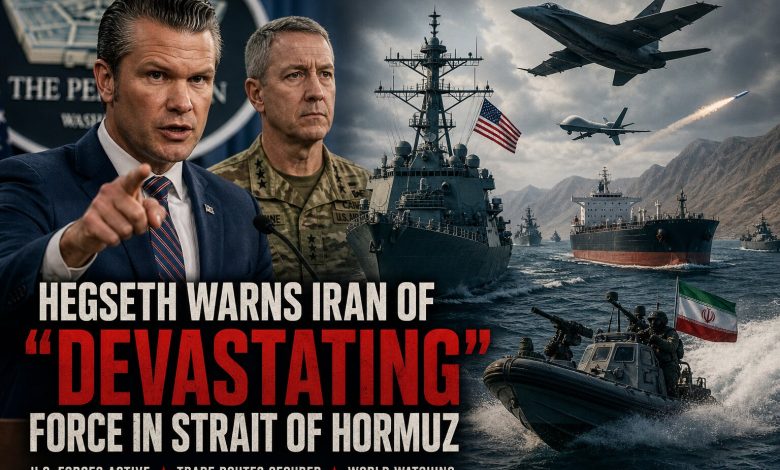
The U.S. War Department and Joint Chiefs of Staff have signaled a significant escalation in maritime enforcement, confirming that American forces are now actively engaging Iranian threats to secure global trade routes.
War Department Secretary Pete Hegseth and General Dan Caine briefed the public on Tuesday regarding the current status of Operation Freedom. The mission, designed to protect commercial shipping in the Strait of Hormuz, has shifted from a monitoring posture to active escorting and defensive engagement following repeated Iranian provocations.
Table of Contents
Strategic Objectives of Operation Freedom
Operation Freedom remains focused on ensuring the unhindered flow of global commerce through the strategic waterway. According to Department data, roughly one-fifth of the world’s oil supply passes through the Strait, making its stability a cornerstone of international economic security.
Secretary Hegseth stated that the United States is currently blocking Iranian vessels from departing their ports while simultaneously providing direct naval protection to American-flagged commercial ships. The Secretary emphasized that while a ceasefire remains technically in place, the U.S. will not tolerate an "illegal tolling system" or "international extortion" by Iranian forces.
Recent Tactical Engagements and Threats
General Dan Caine reported that Iranian elements have conducted more than 10 attacks on U.S. forces and nine strikes on commercial vessels over the past seven weeks. These actions have utilized a variety of specialized hardware, including:
-
Unmanned aerial vehicles (drones)
-
Anti-ship cruise missiles
-
Small, agile attack boats
General Caine noted that despite the "fractured" nature of Iranian command and control, the threat remains persistent. U.S. naval and aviation units, including guided-missile destroyers and over 100 aircraft, are maintaining an enhanced security zone along the southern portion of the Strait.
Economic Impact and Regional Instability
The security crisis has left approximately 2,500 mariners aboard more than 1,500 commercial vessels stranded in the region. The disruption extends beyond the Strait, with reported Iranian strikes hitting targets in Oman and the United Arab Emirates.
Secretary Hegseth argued that the responsibility for long-term stability should be shared by international partners who rely on the waterway. "The world needs this waterway a lot more than we do," Hegseth noted, suggesting that the current heavy U.S. presence is a stabilizing bridge toward a multilateral security solution.
The Status of the Ceasefire
The administration maintains that the ceasefire with Iran is not officially broken, despite recent exchanges of fire. This distinction allows the military to conduct "laser-focused" defensive operations without triggering a return to full-scale combat.
Secretary Hegseth clarified that any decision to escalate the conflict further remains with President Donald Trump. He reiterated that U.S. forces are currently "locked and loaded" to respond to any threat, regardless of whether the attacking force is a major naval vessel or a lightly armed small boat.
Technical Scope of the Deployment
The Pentagon confirmed that approximately 15,000 U.S. service members are currently assigned to Operation Freedom. This force provides 24-hour coverage of the transit lanes, ensuring that any commercial vessel moving through the enhanced security zone is surrounded by visible U.S. combat power.
Future Outlook for Maritime Security
The immediate goal of Operation Freedom is to stabilize the shipping lanes enough for global commercial traffic to resume normal operations. As U.S. forces move to reopen these lanes, officials expect further "low-level" friction but maintain that the strategic advantage lies with the superior intercept capabilities of the U.S. Navy and Air Force.
The Department will continue to monitor Iranian movements, particularly those involving the seizure of foreign vessels. As of this week, Tehran has successfully seized two ships since the ceasefire was announced, a trend General Caine described as "grasping at straws" in the face of overwhelming American maritime superiority.





Leave a Reply
Thank you for your response.
Please verify that you are not a robot.