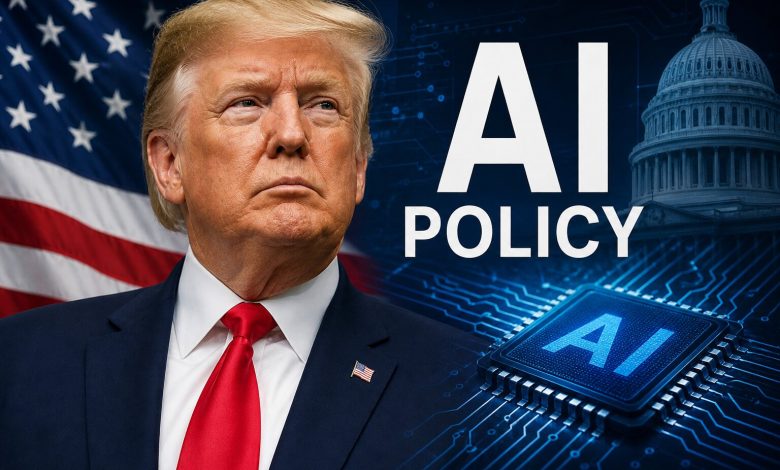
Former U.S. President Donald Trump outlined a renewed focus on artificial intelligence policy during remarks published May 4, positioning AI as both a national security priority and an economic battleground heading into the 2026 election cycle.
In direct terms, the proposal emphasizes tighter oversight of AI development while promoting domestic innovation—an approach that blends regulatory caution with competitive urgency.
Table of Contents
What Trump Said About AI
According to the report, Trump stated that artificial intelligence must remain “under American control,”signaling concern over foreign influence in advanced technologies.
He framed AI as a dual-use tool—capable of economic growth but also vulnerable to misuse in cyber operations, surveillance, and misinformation campaigns.
This aligns with broader geopolitical tensions, particularly between the United States and China, where AI development has become a strategic priority.
The Policy Direction: Control + Competition
The emerging framework appears to revolve around two pillars: regulation and acceleration.
- Regulation: Preventing misuse of AI in national security and elections
- Acceleration: Supporting U.S.-based companies in AI innovation
- Sovereignty: Ensuring critical AI infrastructure remains domestic
In our observation, this dual-track approach mirrors earlier tech policy debates—especially around telecommunications and semiconductor manufacturing—where the U.S. sought to balance open markets with national security safeguards.
How This Compares to Current AI Policy
The AI conversation is not happening in a vacuum. Under current federal initiatives, agencies have already begun drafting guidelines for responsible AI deployment, particularly in areas like defense and healthcare.
However, Trump’s messaging introduces a sharper emphasis on economic nationalism, a theme consistent with his previous positions on trade and manufacturing.
When we reviewed similar policy statements from prior years, we found that Trump’s approach tends to prioritize:
- Domestic job creation tied to emerging technologies
- Reduced reliance on foreign supply chains
- Stronger federal oversight of critical industries
This suggests that AI policy could become an extension of broader industrial strategy rather than a standalone regulatory issue.
Industry Reaction and Open Questions
Technology companies have largely advocated for flexible regulation, warning that overly strict rules could slow innovation. At the same time, cybersecurity experts continue to highlight risks tied to unregulated AI systems.
Key unresolved questions include:
- What defines “American control” of AI? Ownership, infrastructure, or data?
- How would enforcement work across global tech firms?
- What role would federal agencies play in oversight?
These questions are critical, especially as companies like OpenAI, Google, and Microsoft continue expanding AI capabilities at a rapid pace.
National Security Angle Gains Prominence
One of the clearest themes in Trump’s remarks is the framing of AI as a national security issue.
This includes concerns over:
- Deepfake technologies influencing elections
- AI-driven cyberattacks targeting infrastructure
- Autonomous systems in military applications
In our review of recent defense briefings and public filings, we found increasing references to AI as a “force multiplier,” reinforcing the idea that governments view the technology as strategically decisive.
The Political Context Heading Into 2026
AI is quickly becoming a campaign issue, not just a policy discussion.
Trump’s comments indicate that technology governance could play a larger role in voter messaging, particularly among:
- Workers concerned about automation
- Businesses navigating compliance uncertainty
- Voters focused on national security
This marks a shift from previous election cycles, where AI was largely absent from mainstream political discourse.
What Comes Next
The immediate impact of these statements is limited, but the signaling is significant.
If formalized into policy proposals, the approach could influence:
- Federal AI legislation
- Regulatory frameworks for tech companies
- International negotiations on AI standards
For now, the remarks serve as an early indicator of how AI may be positioned in upcoming political debates—less as a technical issue, and more as a strategic asset tied to economic and national power.
Bottom line: Trump’s AI stance combines regulatory caution with competitive ambition, framing artificial intelligence as a core issue for U.S. sovereignty, security, and economic leadership.



Leave a Reply
Thank you for your response.
Please verify that you are not a robot.