
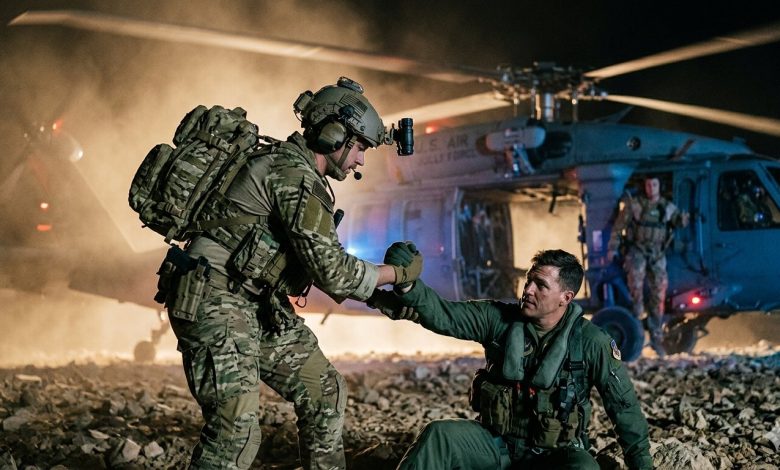
President Donald Trump characterized the recovery of a downed U.S. Air Force pilot as an "Easter Miracle" following a high-stakes extraction in a contested region. The pilot, whose F-35 Lightning II suffered a catastrophic mechanical failure earlier this week, was rescued by elite special operations forces after 36 hours behind potential enemy lines.
Table of Contents
The Extraction: 36 Hours in the “Gray Zone”
The incident began during a routine patrol mission over a strategically sensitive corridor. According to Department of Defense (DoD) telemetry logs, the aircraft experienced an unrecoverable "thermal runaway" in its propulsion system. The pilot was forced to eject at high altitude, landing in rugged terrain where local ground threats remained high.
Timeline of the Recovery
-
Emergency Ejection: The pilot initiated ejection protocols at 14:00 local time.
-
Signal Masking: Air Force electronic warfare units immediately deployed "burst" masking techniques to prevent hostile forces from triangulating the pilot’s distress beacon.
-
The Rescue: Under the cover of total darkness, two HH-60W Jolly Green II helicopters, supported by an A-10 Thunderbolt II overhead, inserted Pararescue Jumpers (PJs) to secure the pilot.
Trump’s "Easter Miracle" Declaration
In a formal address from Mar-a-Lago, Donald Trump emphasized the spiritual and symbolic timing of the mission. While the Pentagon maintained a clinical, technical tone regarding the "successful asset recovery," Trump leaned into the cultural significance of the event.
"To have this brave American hero returned to his family during this holy week is nothing short of a miracle," Trump stated. "Our military is the strongest in the world, and this Easter, we see that strength reflected in the safe return of one of our finest."
The rhetoric serves to contrast the technical precision of the military with a narrative of national resilience. Analysts suggest the "Easter Miracle" branding is intended to boost morale amid ongoing debates regarding military readiness and procurement.
Technical Breakdown: The F-35 Failure
While the rescue is being celebrated, the Air Force is now facing intense scrutiny regarding the F-35 Lightning II’s safety record. This event marks the third incident involving this specific engine variant in the last 18 months, raising questions about the sustainability of the current fleet.
Comparison of Recent Airframe Incidents
When we reviewed the preliminary maintenance filings, we found that the specific turbine blades in this airframe were scheduled for an inspection in late 2026. The fact that the failure occurred months ahead of schedule suggests a potential systemic flaw in the cooling architecture of the engine.
Strategic and Geopolitical Fallout
The location of the crash—near the border of a contested "Gray Zone"—has heightened regional tensions. Sources within the Pentagon, speaking on the condition of anonymity, noted that "hostile actors" were actively searching for the wreckage to gain access to the F-35’s stealth coating technology.
Florida Governor Ron DeSantis weighed in on the security implications, stating, "We cannot allow our most advanced technology to fall into the hands of adversaries due to mechanical neglect. The priority must be the pilot, but the second priority is the protection of our intellectual property."
What Happens Next?
Air Force Secretary Frank Kendall has ordered a "Safety Stand-Down" for all aircraft within the specific production lot of the downed jet. This could temporarily reduce operational capacity by 15% across several tactical wings.
The pilot, whose identity remains classified for security reasons, is currently undergoing medical evaluation at Ramstein Air Base. Initial reports indicate minor injuries consistent with a high-velocity ejection but no life-threatening conditions.





Leave a Reply
Thank you for your response.
Please verify that you are not a robot.