
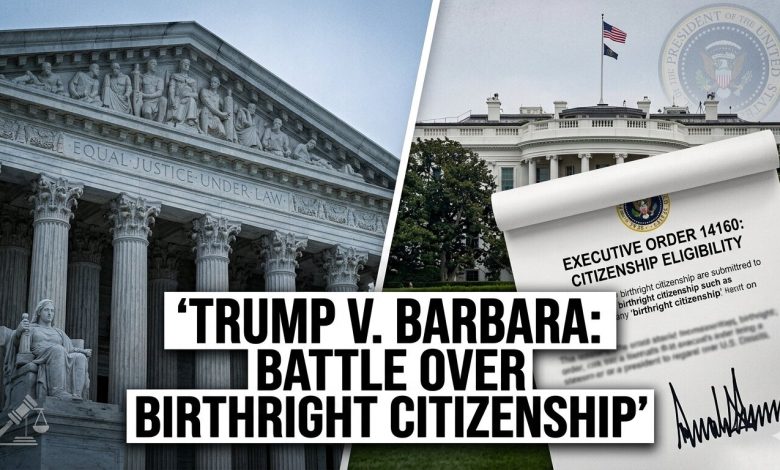
The U.S. Supreme Court appeared likely to reject President Donald Trump’s executive order seeking to end birthright citizenship following oral arguments in Trump v. Barbara on April 1, 2026.
During the high-stakes session, a majority of the justices—including members of the court's conservative wing—questioned the administration's authority to redefine the 14th Amendment’s Citizenship Clause through executive action. The order, signed on the first day of the president's second term, directs federal agencies to deny citizenship documents to children born on U.S. soil if their parents lack permanent legal status.
Table of Contents
The Legal Challenge: Trump v. Barbara
The case reached the Supreme Court after multiple lower courts issued nationwide injunctions, finding the policy likely unconstitutional. Solicitor General D. John Sauer argued that the phrase "subject to the jurisdiction thereof" in the 14th Amendment excludes children of those who do not owe "direct and immediate allegiance" to the United States, such as undocumented immigrants or those on temporary visas.
However, several justices pointed to the 1898 precedent United States v. Wong Kim Ark, which established that birth on U.S. soil confers citizenship regardless of parental status, with very narrow exceptions for diplomats or invading forces. Justice Sonia Sotomayor was particularly vocal, questioning the logic of a prospective-only order. "The logic of your position, if accepted, is that this president or the next president or Congress or someone else could decide that it shouldn't be prospective," she told Sauer. "There would be nothing limiting that, according to your theory."
Key Provisions of Executive Order 14160
When we reviewed the filing, we found the administration's primary goal is to shift the burden of proof onto parents. Under the order:
-
Parental Status Verification: Newborns would no longer receive automatic Social Security numbers based solely on a birth certificate.
-
Exclusion Criteria: Citizenship would be denied if the mother is unlawfully present OR on a temporary visa (student, work, or tourist) while the father is neither a citizen nor a lawful permanent resident.
-
Document Denial: The Secretary of State and Commissioner of Social Security are directed to withhold passports and Social Security cards from affected infants.
Constitutional Conflict and Precedent
The administration contends that birthright citizenship acts as a "magnet" for illegal immigration and that the 14th Amendment was never intended to cover the children of those present in the country illegally. This "originalist" interpretation argues that "jurisdiction" implies a political allegiance that undocumented individuals cannot possess.
Opponents, including a broad coalition led by the ACLU and the Legal Defense Fund, argue that this interpretation flouts over a century of settled law. "All of us born in this country are Americans, as guaranteed by the 14th Amendment," stated Cecillia Wang, ACLU national legal director, following the arguments. The challengers emphasize that the Amendment was designed precisely to prevent the creation of a permanent, multigenerational subclass of residents who are denied full rights despite being born within the nation's borders.
The Scope of “Jurisdiction”
A central point of contention during the April 1 arguments was the definition of "subject to the jurisdiction." The government’s implementation plan, as outlined in internal USCIS documents, defines "unlawfully present" as being in the U.S. without admission or parole, or remaining after an authorized stay has expired.
Justice Clarence Thomas noted that historical debates around the 14th Amendment focused primarily on the status of formerly enslaved people. However, several conservative justices seemed wary of the executive branch's attempt to bypass Congress and the amendment process to alter a fundamental tenet of American law.
Economic and Administrative Consequences
Beyond the legal theory, the practical implications of E.O. 14160 are vast. A study from the National Foundation for American Policy estimated that ending birthright citizenship would cost parents approximately $600 in government fees to prove the citizenship status of each baby, with legal fees potentially adding another $600 to $1,000 per family.
Furthermore, state governments—tasked with recording births—would face significant administrative costs to coordinate with federal agencies. Currently, birth certificates are the primary evidence of citizenship; under the Trump order, every single newborn in the U.S. could be subjected to a federal verification process to confirm their parents' status before being issued a Social Security number.
A final decision from the Supreme Court is expected by the end of the term in late June or early July 2026. If the Court strikes down the order, it would reaffirm the long-standing principle of jus soli (right of the soil) as the definitive standard for American citizenship. If upheld, it would represent the most significant shift in U.S. citizenship law since the Reconstruction era.



Leave a Reply
Thank you for your response.
Please verify that you are not a robot.