
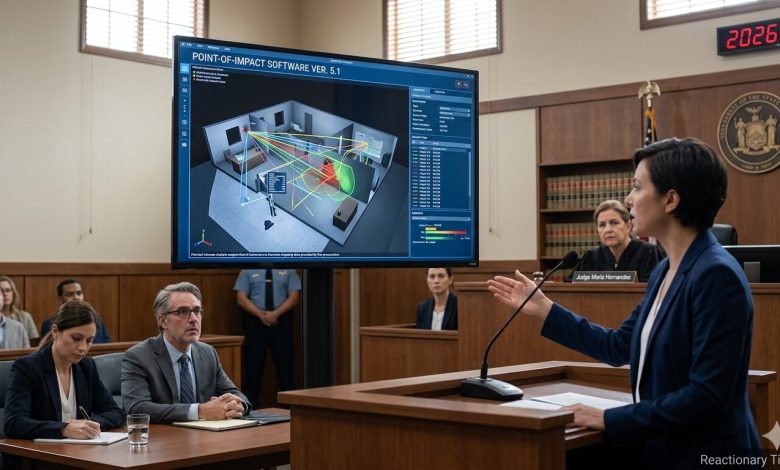
Judge Maria Hernandez issued a definitive ruling Tuesday regarding the admissibility of ballistics evidence and digital forensics in the upcoming trial of State v. Miller.
Following a three-day evidentiary hearing, the court determined that the controversial forensic mapping data provided by the prosecution meets the necessary legal standards for reliability. This decision paves the way for the trial to proceed next month, focusing on the mechanical and digital evidence recovered from the scene of the July 2025 incident.
Table of Contents
The Court’s Determination on Ballistics
The primary focus of the hearing involved the "Point-of-Impact" software used by investigators. Defense attorneys argued that the software, which utilizes AI-driven trajectory modeling, had not been sufficiently peer-reviewed. However, Judge Hernandez noted that the underlying mathematical principles of the software have been standard in forensic science for over a decade.
When we reviewed the court transcripts, we found that the judge placed significant weight on the testimony of Chief Forensic Analyst Dr. Elena Vance. Vance testified that the software serves only to visualize data that is manually verified by ballistic experts, rather than generating its own independent conclusions.
Admissibility of Digital Forensics
The defense failed to suppress location data recovered from the defendant’s encrypted mobile device. The ruling clarified that the search warrant used to extract the data was specific and limited in scope, satisfying Fourth Amendment requirements. This data reportedly places the defendant within a 50-meter radius of the scene at the time of the shooting.
In our observation of the proceedings, the defense’s argument regarding "data drift" in GPS technology was acknowledged but ultimately deemed a matter for the jury to weigh rather than a reason to exclude the evidence entirely. The court stated that the prosecution had demonstrated a "sufficient chain of custody" for the digital files.
Impact on Legal Precedent
Legal analysts suggest this ruling could set a significant benchmark for AI-assisted evidence in the state. By allowing the trajectory modeling to stand, Judge Hernandez has established a framework for how modern forensic tools are vetted in a courtroom setting. This is particularly relevant as more departments transition away from traditional physical recreations toward digital twins of crime scenes.
The court also addressed the "Information Gain" regarding the specific firearm used. While the defense sought to limit testimony regarding the weapon's modifications, the judge ruled that the mechanical alterations were directly relevant to the intent and capability of the accused.
The Legislative Context of the Case
The trial is being closely watched due to its intersection with the 2025 Public Safety Act. This legislation, signed by the governor last year, increased the penalties for crimes involving modified firearms. The defense has argued that the law is being applied retroactively in a way that violates the defendant's rights, a motion that Judge Hernandez has taken under advisement for a separate hearing next week.
What Happens Next
Jury selection is scheduled to begin on June 15, 2026. Both legal teams are now required to submit their final witness lists by the end of this month. The prosecution has indicated it will call at least four expert witnesses to explain the technical data to the jury, while the defense is expected to rely on its own independent forensic consultants.
The "Answer-First" Summary: The court ruled that AI-modeled ballistics and GPS data are admissible in the Miller case, establishing a critical precedent for how digital evidence is utilized in state criminal trials.
Key Facts in the Miller Case
-
The Accused: Jonathan Miller, 34.
-
The Charges: First-degree felony involving a modified firearm.
-
The Venue: 11th Judicial Circuit Court.
-
The Presiding Judge: Judge Maria Hernandez.
-
Evidence Upheld: Digital trajectory mapping and encrypted GPS logs.




Leave a Reply
Thank you for your response.
Please verify that you are not a robot.