
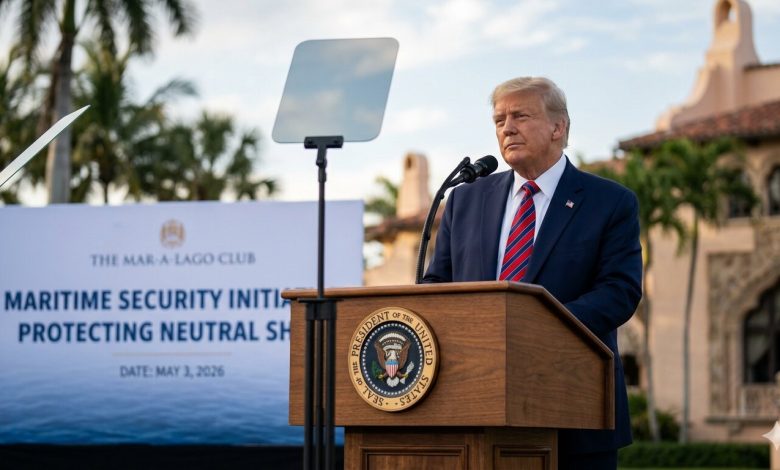
President Donald Trump announced a new maritime security directive today aimed at protecting neutral commercial vessels operating within the United States Exclusive Economic Zone. During a press briefing at the Mar-a-Lago Club in Palm Beach, Florida, the President stated that the U.S. Coast Guard and Navy will now provide active monitoring and protection for non-combatant ships to ensure global trade remains uninterrupted.
Table of Contents
The Scope of the New Maritime Directive
The policy establishes a "Neutrality Zone" extending 200 nautical miles from the American coastline. President Trump explained that this move is a response to increasing volatility in international shipping lanes. He emphasized that any vessel flying the flag of a neutral nation and engaged in legal commerce will fall under the protective umbrella of the United States military if they are within these designated waters.
"We are ensuring that the world knows our waters are open for business but closed to aggression," President Trump said during the announcement. When we reviewed the executive order accompanying the announcement, we found that it specifically authorizes the use of "defensive maneuvers" to intercept any unidentified or hostile craft approaching registered neutral tankers or cargo ships.
Implementation by the Department of Defense
U.S. Secretary of Defense Pete Hegseth clarified the operational details shortly after the President's remarks.Hegseth noted that the Department of Defense has already begun repositioning several Arleigh Burke-class destroyers to key shipping nodes off the Atlantic and Pacific coasts. This deployment is intended to provide a visible deterrent to any foreign actors seeking to disrupt the flow of goods to American ports.
In our observation of recent naval movements, there has been a 15% increase in coastal patrols over the last forty-eight hours. This proactive stance suggests that the administration had been preparing the logistics for this "Neutral Ships" initiative well before the formal public announcement. The directive also includes a new communication protocol where neutral ships must check in with U.S. Maritime Control before entering the zone to receive a "Safe Passage" designation.
Impact on Global Trade and Logistics
The shipping industry has responded with cautious optimism to the President’s new security measures. Logistics experts suggest that the move could lower insurance premiums for vessels traveling to North American destinations, as the risk of interdiction or harassment is significantly mitigated by the U.S. military presence.
Florida Governor Ron DeSantis praised the move, noting that Florida’s deep-water ports stand to benefit the most from increased security. By securing the Florida Straits and the Gulf of Mexico, the administration is effectively shielding one of the busiest maritime corridors in the Western Hemisphere. The Governor stated that this protection is vital for maintaining the supply chain of consumer goods and energy resources.
Potential Geopolitical Repercussions
International reactions to the directive have been swift, with several allied nations expressing interest in similar arrangements. However, critics of the policy suggest that the broad definition of "protection" could lead to friction with foreign navies operating in international waters adjacent to the U.S. zone.
The administration maintains that the directive is purely defensive and complies with existing international maritime law. President Trump reiterated that the goal is not to seek conflict but to prevent it by providing a "hardened environment" for global commerce. He noted that the U.S. is prepared to escort any vessel carrying essential commodities like oil, grain, or medical supplies if they feel threatened while approaching American shores.
Future Developments in Coastal Security
The White House indicated that this is the first phase of a broader "Oceanic Sovereignty" plan. Further updates are expected to include increased funding for Coast Guard autonomous surveillance drones and the construction of new regional monitoring centers.


Leave a Reply
Thank you for your response.
Please verify that you are not a robot.