
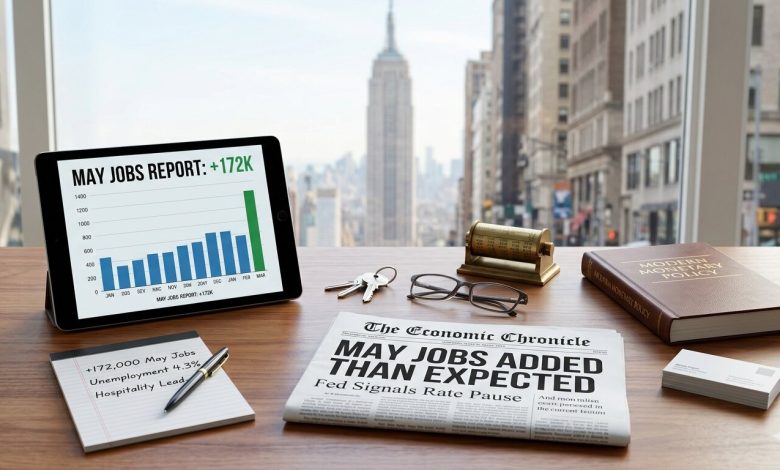
The US economy added 172,000 jobs in May 2026, significantly outpacing economic forecasts and providing the Federal Reserve with substantial leverage to pause planned interest rate cuts. The Bureau of Labor Statistics reported that the national unemployment rate held steady at 4.3%, demonstrating a resilient labor market that continues to defy broader economic cooling trends.
Table of Contents
Breaking Down the May Labor Data
When we reviewed the filing from the Bureau of Labor Statistics, we found that May’s growth heavily outpaced the consensus economist estimate of roughly 80,000 new positions. This upside surprise follows a quiet 2025 where employers largely paused hiring due to volatile US tariff policies and federal spending cutbacks.
In our observation of the revised historical data, the government also quietly updated its March and April hiring figures upward by a combined 93,000 jobs. This indicates that the labor market's momentum entering the summer season was vastly underestimated by Wall Street analysts.
Leisure and Hospitality Drive Growth Ahead of World Cup
Sector-by-sector data reveals a highly uneven distribution of labor gains across the domestic economy, heavily influenced by localized seasonal demands.
-
Leisure and Hospitality: Led all sectors by adding 70,000 positions, heavily stimulated by early corporate preparation for the upcoming summer World Cup matches hosted in the United States.
-
Public Sector: Local government payrolls expanded by 55,000 jobs, primarily reflecting seasonal educational and community hiring cycles.
-
Healthcare Services: Maintained its multi-year expansion trend by generating 35,000 new payroll positions.
-
Financial Sector: Stood out as a major area of contraction, actively shedding 22,000 professional positions during the month.
Average hourly earnings rose 0.3% for the month, translating to a 3.4% annualized growth rate. This wage data closely matched consensus expectations, proving that while hiring volume remains highly elevated, actual wage inflation is not accelerating rapidly.
Market Turmoil and Political Friction
The broader financial markets reacted negatively to the robust data, as investors quickly recalibrated their expectations for near-term monetary easing. The Dow Jones Industrial Average dropped 695 points, representing a 1.4% single-day decline, while a severe tech selloff pulled the Nasdaq down by 4.2% to cap off its worst trading week in more than a year. The S&P 500 closed the session down 2.6%.
The market reaction triggered immediate political commentary on social media. President Donald Trump criticized the negative market movement on Truth Social, arguing that economic growth should not be treated as an automatic indicator of inflation and that stock prices should naturally move higher alongside strong employment numbers.
The Professional Services Disconnect
A deeper analysis of the Labor Department's data reveals an underlying structural disconnect between active corporate job openings and actual physical hiring.
Separate data released earlier in the week showed that US job openings rose sharply to 7.62 million in April, marking the highest level since May 2024. This surge was almost entirely driven by the professional and business services sector, which accounted for approximately 90% of the nationwide increase by adding 668,000 open listings.
However, despite this massive spike in white-collar job postings, actual employment within the professional and business services sector remained practically unchanged in May. This discrepancy suggests a corporate landscape where businesses are actively listing positions and searching for talent, yet remain highly cautious about officially expanding their payrolls amid broader macro uncertainties.
Federal Reserve Implications
The sustained strength of the labor market directly complicates the Federal Reserve's policy roadmap for the second half of 2026. With the unemployment rate hovering tightly between 4.3% and 4.5% since July 2025, central bank policymakers face little immediate pressure to stimulate the economy through rate reductions.
Economic experts note that as long as consumer spending holds up and businesses continue broad-based hiring outside of isolated corners like finance, the Fed is highly likely to keep the benchmark interest rate elevated. The persistent resilience of these core pillars ensures that the central bank can remain patient, monitoring lagging inflation metrics without fearing an imminent breakdown in the domestic labor market.



Leave a Reply
Thank you for your response.
Please verify that you are not a robot.