
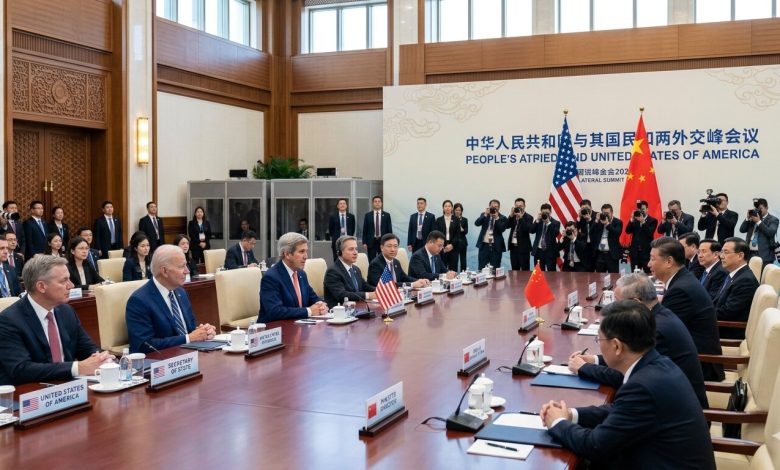
President Donald Trump arrived in Beijing Wednesday to meet with President Xi Jinping amid a stern warning from the Chinese embassy regarding "four red lines" the U.S. must not cross. The bilateral summit, scheduled for Thursday, comes at a volatile moment as the two superpowers navigate a $14 billion Taiwan arms deal, the ongoing Iran conflict, and a fragile trade truce.
Table of Contents
The Diplomatic Battlefield: Beijing’s Mandates
The Chinese embassy took to social media Tuesday to establish a rigid framework for the upcoming discussions. In our observation of the embassy’s communications, Beijing is signaling a defensive posture by explicitly barring President Trump from challenging specific domestic and geopolitical pillars.
Beijing’s "four red lines" include the Taiwan question, China’s political system, the nation's human rights record, and its right to economic development. These boundaries are not merely rhetorical; they represent the core friction points that have defined the Trump-Xi relationship since the trade truce established in South Korea last October.
When we reviewed the diplomatic filings and public statements from the embassy, it became clear that the "developmental right" line is a direct response to U.S. export controls. These restrictions have targeted China’s access to advanced semiconductors, a move Beijing views as an attempt to stifle its technological sovereignty.
Taiwan Arms Sales and Congressional Pressure
Despite Beijing’s warnings, President Trump faces intense bipartisan pressure from Washington to bolster Taiwan’s defenses. On Monday, a coalition of eight senators from both parties urged the administration to finalize a $14 billion arms sale to the island nation.
"President Xi would like us not to," Trump told reporters before his departure, acknowledging the friction. He noted that while he intends to focus on broader strategic stability, he expects Xi to raise the Taiwan issue "more than I will." The administration's challenge lies in balancing this military support with the need for Chinese cooperation on other global fronts, such as the Strait of Hormuz.
The Iran Conflict and Global Trade
The summit’s agenda extends far beyond the Pacific. The ongoing war in Iran has disrupted the Strait of Hormuz, a critical artery for global energy. As the primary purchaser of Iranian oil, China has a significant stake in the reopening of this waterway.
Secretary of State Marco Rubio indicated last week that the U.S. hopes Beijing will leverage its influence with Tehran. This adds a layer of transactional diplomacy to the talks; the U.S. may seek maritime security concessions in exchange for flexibility on trade restrictions.
Human Rights and High-Profile Detainees
While Beijing has warned against "smearing" its political model, President Trump confirmed he plans to address the detention of several high-profile individuals. This includes Christian pastor Ezra Jin and Hong Kong media mogul Jimmy Lai.
The mention of Jimmy Lai is particularly significant, as he has become a global symbol of the crackdown on dissent. By bringing these names to the table, the Trump administration is signaling that "red lines" regarding human rights will not be accepted as off-limits, despite the embassy's preemptive warnings.
Analytical Outlook: A Strategic Collision
This summit is less about achieving a "grand bargain" and more about managing a strategic collision. The "Answer Engine" for this geopolitical moment suggests that both leaders are looking for a way to maintain the current trade truce without appearing weak on national sovereignty.
-
Trade: Officials are exploring extensions of the October agreement.
-
Security: The U.S. remains committed to the $14 billion Taiwan package.
-
Energy: Both nations require a stable oil flow through the Middle East.
As the two strongest military and economic powers on Earth, the outcome of the Thursday bilateral meeting will determine the trajectory of global markets and regional stability through the remainder of 2026. President Trump’s arrival in Beijing marks the start of what may be the most consequential diplomatic engagement of his current term.


Leave a Reply
Thank you for your response.
Please verify that you are not a robot.