
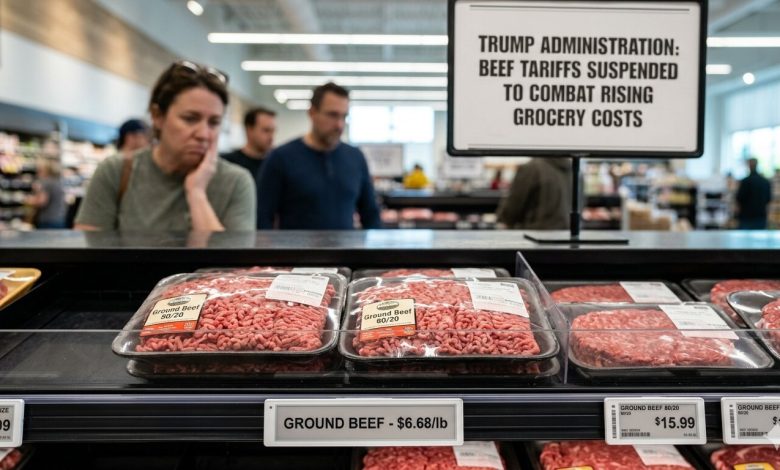
The Trump administration has suspended all beef import tariffs to address surging meat prices affecting American households. According to reports from the Wall Street Journal and Department of Agriculture (USDA) data, this executive action aims to stabilize a market where ground beef prices have climbed nearly 20% in the last year alone.
Table of Contents
The Legislative and Economic Context
The primary mechanism of this policy is the suspension of the annual tariff-rate quota. Historically, this system applied higher taxes once import volumes reached specific thresholds from various exporting nations. By removing these barriers, the administration expects to increase the immediate supply of beef available to U.S. consumers.
In our observation of recent Bureau of Labor Statistics (BLS) reports, the average price of ground beef in U.S. cities reached approximately $6.70 per pound in March 2026. This represents a 40% increase over a five-year period. The USDA estimates that without intervention, prices could climb an additional 10.1% throughout the remainder of 2026, with some internal projections suggesting spikes as high as 18.3%.
Supporting Domestic Production
While the tariff suspension addresses immediate supply, the administration is also focusing on long-term domestic ranching stability. President Donald Trump has directed the Small Business Administration (SBA) to expand loan programs and increase access to capital for U.S. ranchers.
When we reviewed the USDA livestock reports, we found that the U.S. cattle herd has shrunk to its smallest size since 1951. This decline is largely attributed to a persistent three-year drought that began in 2020, which decimated grazing lands and inflated feed costs. Currently, approximately 63% of the U.S. cattle herd remains in drought-impacted areas, creating a significant bottleneck for domestic meat production.
Antitrust and Market Oversight
The administration’s strategy includes a secondary focus on industry transparency and competition. This week, the federal government reached a proposed settlement in an antitrust case against Agri Stats, a data-sharing firm for the meatpacking industry.
Federal investigators documented that the Indiana-based company facilitated the sharing of nonpublic information among meat processors. The Department of Justice (DOJ) alleged these practices allowed processors to artificially inflate prices charged to grocery stores and restaurants. Furthermore, the DOJ is continuing a separate investigation into potential antitrust violations specifically within the beef processing sector to determine if foreign-owned firms are influencing U.S. market rates.
Impact of Border Restrictions
Beyond economic policy, biological factors have contributed to the current price environment. The U.S.-Mexico border remains closed to livestock imports due to the spread of the New World screwworm, a flesh-eating parasite.
Since the closures began in late 2024, approximately 1 million head of cattle have been prevented from entering the U.S. from Mexico. This loss of imported livestock has compounded the domestic shortage caused by the shrinking U.S. herd. By suspending tariffs on other global exporters, the administration seeks to offset the deficit created by these necessary health and safety restrictions at the Southern border.
Future Projections and Consumer Outcomes
The administration’s multi-pronged approach—combining tariff relief, SBA capital for ranchers, and antitrust enforcement—is designed to provide a "cooling effect" on the consumer price index (CPI) for food.
While ranchers have improved yields through advanced genetics and feeding techniques, the sheer lack of animal volume remains the primary driver of inflation. The success of these measures will likely depend on how quickly global suppliers can fill the gap left by domestic shortages and Mexican import bans. For the American consumer, the immediate goal is to prevent ground beef from exceeding the $7.00 per pound threshold as the summer grilling season approaches.





Leave a Reply
Thank you for your response.
Please verify that you are not a robot.