
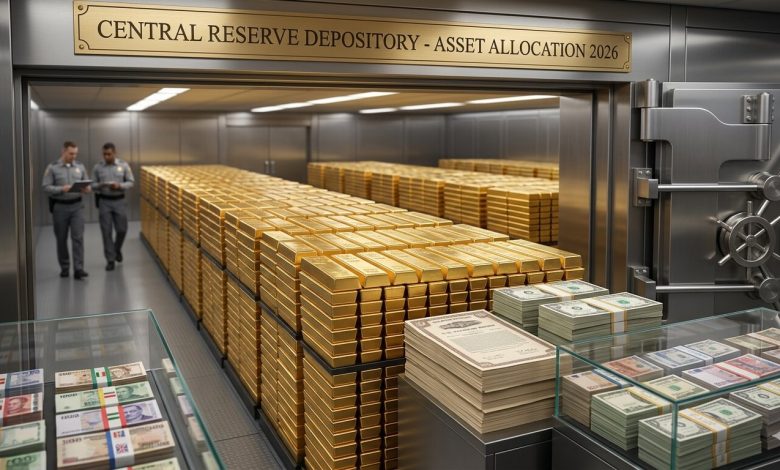
Global central banks are prioritizing physical gold over U.S. government debt to safeguard national wealth. The structural shift in sovereign reserve management reached a historical milestone as gold officially surpassed U.S. Treasuries in global reserve portfolios.
When we reviewed the allocation data from the end of 2025, we found that gold accounted for 27% of global central bank reserve assets. This represents a significant increase from the 20% allocation recorded just one year prior. Meanwhile, U.S. Treasuries fell behind, accounting for roughly 20% of global central bank reserve assets at the end of 2025.
Table of Contents
Geopolitical Triggers Driving De-Dollarization
Sovereign nations are moving away from G7 financial instruments following the freeze of Russian foreign reserves. In February 2022, the United States and its allies blocked Russia's access to its overseas financial assets, which included approximately $3.9 billion in U.S. Treasury securities.
In our observation, this action fundamentally changed how reserve managers evaluate political risk. Unlike digital bank deposits, debt securities, or international clearance mechanisms, physical gold stored within a nation's own borders cannot be frozen, seized, or canceled by a foreign superpower.
The structural migration toward bullion is concentrated in emerging markets that seek protection from Western economic sanctions. European Central Bank research documents that the primary institutions driving this accumulation include the People's Bank of China, the National Bank of Poland, the Central Bank of the Republic of Turkey, and the Reserve Bank of India.
Escalating Debt and Currency Valuations
America's fiscal trajectory is undermining long-term confidence in the stability of the greenback. The United States sovereign debt expanded past $39 trillion in mid-2026, maintaining an annualized growth rate of approximately $2 trillion.
This rapid expansion of supply, paired with persistent geopolitical instability in Western Asia and Eastern Europe, has pushed reserve managers to seek hard-asset alternatives. The massive capital flows into bullion have triggered an unprecedented price expansion over the last four years.
-
Pre-War Baseline: On February 24, 2022, the spot price of gold traded near $1,905 per troy ounce.
-
Historical Peak: The asset hit an all-time nominal high of $5,400 per troy ounce on January 28, 2026.
-
Current Evaluation: As of June 2, 2026, physical gold is trading near $4,555 per troy ounce, representing a 139% price appreciation since the start of the Ukraine conflict.
Market Implications for the U.S. Dollar
The global central bank gold inventory is now valued higher than the total foreign allocation of U.S. sovereign debt. Central banks collectively hold 36,000 metric tons of bullion, carrying an aggregate market value of $5.2 trillion at current prices. In comparison, total foreign official holdings of U.S. Treasuries stand at $3.9 trillion, according to the latest data published by the U.S. Department of the Treasury.
This shift does not mean that the greenback is losing its operational dominance in international commerce. The U.S. dollar still accounts for approximately 42% of global foreign exchange reserves, keeping it securely positioned as the primary global currency.
Private and corporate actors are mirroring this institutional behavior. For example, Tether, the issuer of the world's largest stablecoin, acquired roughly 100 metric tons of physical gold over the course of 2025, deploying $14.6 billion in cash reserves to diversify its backing away from pure debt instruments.
Central banks are signaling that when geopolitical rivalries escalate, physical commodities provide a level of wealth preservation that credit-based paper assets cannot match. While the dollar remains the top operational currency for cross-border banking and trade, gold has reclaimed its position as the ultimate anchor for sovereign financial reserves.





Leave a Reply
Thank you for your response.
Please verify that you are not a robot.