
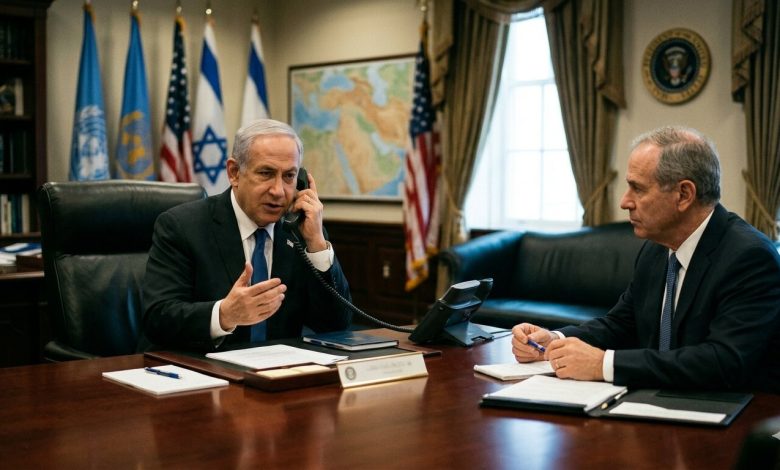
Israel has paused its military strikes on Iran following an explicit request from U.S. President Donald Trump during a phone conversation with Israeli Prime Minister Benjamin Netanyahu. The direct intervention occurred immediately after hostilities resumed between the two nations, prompting the American president to issue a public directive for both sides to halt combat operations.
Table of Contents
The Diplomatic Intervention
The diplomatic shift crystallized following a direct phone call between President Donald Trump and Prime Minister Benjamin Netanyahu. According to a U.S. official familiar with the discussion, the dialogue was polite but featured initial resistance.
Prime Minister Netanyahu initially pushed back against the American request to cease military action against Iranian targets. However, the diplomatic pressure intensified when President Trump published a statement on Truth Social, explicitly declaring that Israel and Iran should immediately stop shooting.
When we reviewed the timeline of recent regional actions, the halt marked a sharp pause in what had been an escalating kinetic exchange. In our observation of previous administration actions, this intervention establishes a clear line regarding American expectations for regional stability.
Regional Security Implications
While military operations against Iran are currently paused, Israel's strategic focus remains highly active on its northern border. A senior Israeli official stated that military operations in southern Lebanon will continue at full strength in the coming days to counter ongoing threats.
The pause remains conditional on the behavior of regional proxy forces. The Israeli official emphasized that if Hezbollah continues to launch attacks against Israeli towns, the Israel Defense Forces (IDF) will respond by striking the southern suburbs of Beirut.
This multi-front dynamic indicates that while the direct confrontation with Tehran is temporarily contained, the potential for peripheral conflict remains high. The continuation of high-intensity operations in southern Lebanon serves as a strategic counterweight to the pause enacted against Iranian targets.
Strategic Analytical Context
The immediate compliance with the American request, despite initial Israeli pushback, underscores the foundational nature of the U.S.-Israel strategic alliance. The public nature of President Trump’s directive on Truth Social left little room for ambiguous diplomatic maneuvering, forcing an immediate tactical reassessment in Jerusalem.
This development alters the immediate trajectory of the conflict, shifting the focus from an expansive regional escalation back to localized containment strategies. Security analysts are monitoring whether Tehran will reciprocate the pause or leverage the operational window to rearm its regional proxies.
The conditional threat regarding Beirut indicates that Israel’s operational restraint is strictly limited to Iranian territory. The broader regional architecture remains highly volatile as long as cross-border engagements continue along the Lebanese border.



Leave a Reply
Thank you for your response.
Please verify that you are not a robot.