
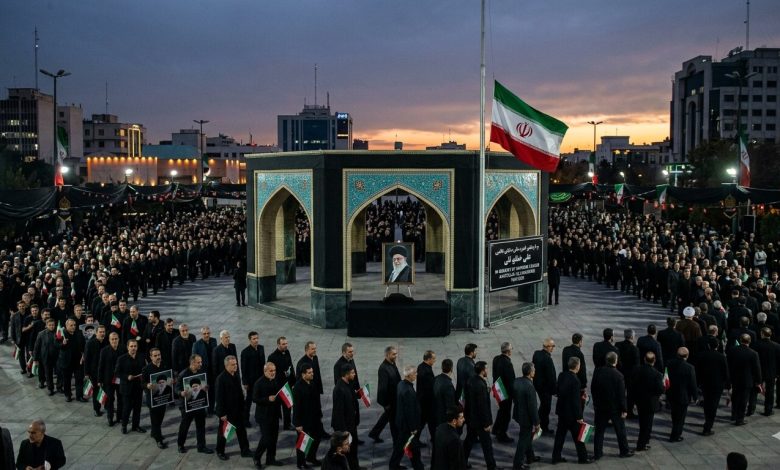
The official funeral proceedings for Iran's late Supreme Leader Ayatollah Ali Khamenei will begin in Tehran on July 4, 2026, culminating in his burial on July 9 in his hometown of Mashhad. State media confirmed the scheduling delay, which follows Khamenei’s death during joint U.S. and Israeli airstrikes on February 28, 2026. The four-month gap between his death and burial marks a significant departure from Islamic customary laws regarding rapid interment.
Table of Contents
Delayed Burials and Broken Customary Law
When we reviewed the state media dispatches, we found that authorities explicitly cited wartime exceptions to justify holding the remains since February. Traditional Islamic jurisprudence mandates that a deceased person must be buried within 24 hours. Iranian state television confirmed that the multi-city funeral procession will stop in the religious center of Qom on July 7 before traveling to northeastern Iran.
In our observation of recent state functions, the prolonged delay highlights the logistical and security challenges facing the regime since the destruction of the central Tehran compound. The multi-month gap allowed the clerical establishment to stabilize the government before inviting large public gatherings.
The Legacy of the 36-Year Autocracy
Ayatollah Ali Khamenei maintained an absolute grip on Iran's political and military institutions for 36 years, transforming the state into a heavily sanctioned, militarily aggressive autocracy. Under his direction, the Islamic Revolutionary Guard Corps (IRGC) established a network of regional proxy forces, including Hezbollah in Lebanon, Hamas in Gaza, and the Houthi movement in Yemen. These operations prioritised regional conflict over domestic economic stabilization.
Domestically, the late Supreme Leader systematically deployed state security forces to suppress popular protests and political dissent. Human rights organizations documented thousands of extrajudicial executions, arbitrary detentions, and violent crackdowns during his tenure. The structural focus on internal surveillance and external military funding resulted in runaway inflation and widespread economic stagnation for the Iranian population.
Dynastic Succession and the Path Forward
The destruction of the supreme leader's compound on February 28 resulted in the immediate, non-democratic elevation of his son, Mojtaba Khamenei, to the position of Supreme Leader. The 56-year-old hereditary successor assumed power despite sustaining injuries in the initial airstrikes that killed his father and political allies.
The political transition bypasses the traditional theological selection process historically managed by the Assembly of Experts. In our analysis of regional diplomatic cables, this rapid hereditary consolidation reveals a deliberate effort to project stability to foreign adversaries while maintaining internal command over the military.
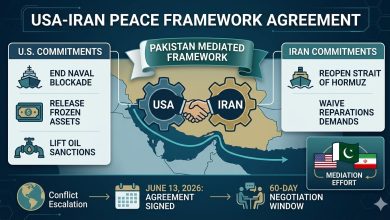
The announcement of the funeral coincides with major diplomatic developments reported by regional intermediaries. Pakistan Prime Minister Shehbaz Sharif stated that Iran and the United States have formulated a preliminary framework for a peace agreement to conclude the three-month war.
The diplomatic document is expected to undergo formal initial signing procedures within the next 24 hours, even as Tehran prepares the highly coordinated, multi-city state funeral for its long-serving autocrat.




Leave a Reply
Thank you for your response.
Please verify that you are not a robot.