
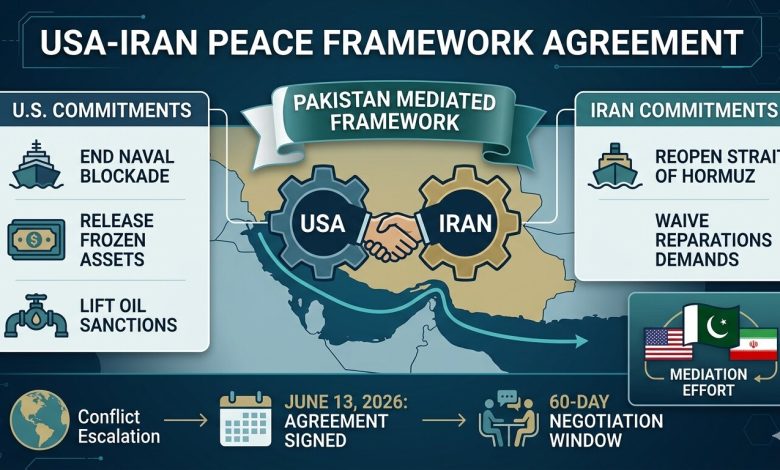
The United States and Iran have agreed on a framework for a peace deal after more than three months of military conflict, with an initial electronic signing expected within 24 hours, Pakistani Prime Minister Shehbaz Sharif stated on June 13, 2026.
In our observation of the fast-moving diplomatic field in Islamabad, the Pakistani government is currently preparing immediate digital protocols to finalize this preliminary memorandum of understanding. The breakthrough follows intensive mediation by Pakistan after a war that escalated global energy volatility and caused thousands of casualties across the Middle East.
Table of Contents
Key Framework Provisions
According to draft terms described by diplomatic sources, the core exchange involves major concessions regarding maritime commerce and state finances. The United States will lift its naval blockade on Iranian ports and begin releasing billions of dollars in frozen Iranian financial assets.
In return, Iran will officially reopen the Strait of Hormuz to commercial shipping traffic and waive previous demands regarding immediate war reparations. The framework allows both nations to transition from active hostility to technical-level negotiations starting next week.
-
Sanctions relief: The U.S. will waive current restrictions on Iranian crude oil exports.
-
Maritime security: Both nations will cease hostile actions within the Persian Gulf and Gulf of Oman.
-
Timeline for implementation: A 60-day window of structured diplomatic talks will follow the electronic signing.
Nuclear Program Disagreements Exist
When we reviewed the initial statements from both capitals, a sharp division emerged regarding the long-term status of Iran’s nuclear capabilities. U.S. President Donald Trump initiated the military campaign on February 28, 2026, citing the destruction of Iran's nuclear infrastructure as his primary strategic objective.
An anonymous U.S. administration official stated that the framework sets a clear path toward the complete dismantling of Iran's nuclear program and the physical destruction of its highly enriched uranium stockpile. However, Iranian Foreign Minister Abbas Araqchi publicly contradicted this interpretation on state television. Araqchi documented that Tehran intends to keep its enriched uranium stockpile in a diluted form and will not accept the absolute dismantling of its facilities.
Ongoing Direct Military Threats
Our analysis indicates that regional stability remains fragile despite the announced diplomatic breakthrough. Hours before the peace framework was finalized, U.S. military forces shot down multiple Iranian one-way attack drones over the Persian Gulf.
U.S. Central Command confirmed that the drones posed a direct threat to commercial shipping lanes near the Strait of Hormuz. The incident underscores the high level of operational tension that local commanders must manage while negotiators formalize the ceasefire rules. Technical delegations from Washington, Tehran, and Islamabad are scheduled to meet in person next week to hammer out verification mechanisms for the 60-day transitional phase.




Leave a Reply
Thank you for your response.
Please verify that you are not a robot.