
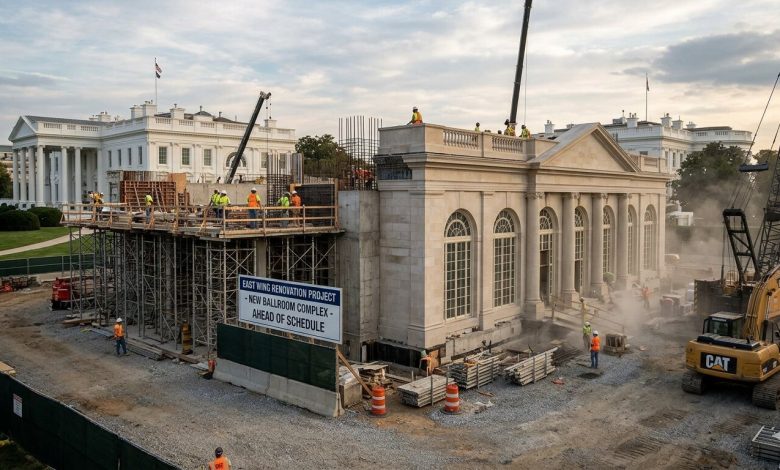
The White House ballroom construction project is ahead of schedule and under budget despite an expansion that doubled its size and initial cost projection.
President Donald Trump confirmed Wednesday that the new facility, located on the East side of the White House, will now cost just under $400 million. This figure represents an increase from the original $200 million estimate, which the President attributed to a significant scale-up in size and quality following "deep-rooted studies."
Table of Contents
Security and Strategic Utility
In our review of the project’s objectives, the administration has shifted focus toward hardening the White House complex against physical threats. The ballroom is designed to host major diplomatic events, meetings, and future inaugurations within a secure perimeter.
The necessity for a dedicated, high-security venue became a priority following the shooting at the White House Correspondents' Association dinner last month. In our observation of Truth Social communications, President Trump stated that moving large-scale events onto secured White House grounds is a critical safety measure. The new facility reportedly includes "every highest level security feature there is" to protect public officials.
Legislative and Legal Landscape
The ballroom is a component of a larger East Wing modernization effort. Senate Republicans recently passed a reconciliation package that includes $1 billion for Secret Service security upgrades. Key figures in the GOP, including Florida Governor Ron DeSantis, have emphasized that these funds are specifically designated for security infrastructure rather than general construction.
The project continues to move forward despite a legal challenge from the National Trust for Historic Preservation. The organization filed suit to halt construction, claiming the administration required explicit congressional approval before breaking ground. However, a federal appeals court has allowed construction to proceed while the case is litigated.
Funding and Economic Context
The ballroom financing is situated within a broader $72 billion GOP-backed package. This legislative effort also provides funding for Immigration and Customs Enforcement (ICE) and Customs and Border Protection (CBP).
Senate Minority Leader Chuck Schumer has voiced opposition to the project, suggesting that the focus on a ballroom comes at the expense of broader economic concerns. Conversely, proponents argue that securing the White House complex is a legitimate national security priority given the current threat environment.
Construction Progress and Specifications
The facility is being built rapidly to accommodate the administration's timeline. President Trump dismissed reports of unexpected cost overruns, maintaining that the budget adjustment was a planned response to the increased scope of the building.
The expansion ensures the venue will be double the size of the original 2026 proposal. By increasing the square footage and technical specifications, the administration intends to create a "magnificent, safe, and secure" environment for the executive branch's future hosting requirements.
Impact on White House Operations
The transition of major events to the new ballroom is expected to change the logistics of presidential social and diplomatic engagements. Historically, large-scale events often required off-site venues which presented complex security challenges for the Secret Service.
Once completed, the East Wing ballroom will centralize these operations. This allows for a permanent security footprint that reduces the personnel and equipment costs associated with securing external hotel ballrooms or convention centers.
Conclusion and Future Outlook
As the project enters its next phase of construction, the administration remains confident in the "ahead of schedule" status. The legal proceedings with the National Trust for Historic Preservation remain the primary obstacle to a seamless completion, though current court rulings favor the continuation of work.
The project stands as a centerpiece of the current administration's effort to modernize government infrastructure while addressing modern security vulnerabilities. With the $400 million investment, the White House aims to establish a venue that meets the dual demands of high-level diplomacy and maximum-security protection for decades to come.





Leave a Reply
Thank you for your response.
Please verify that you are not a robot.