
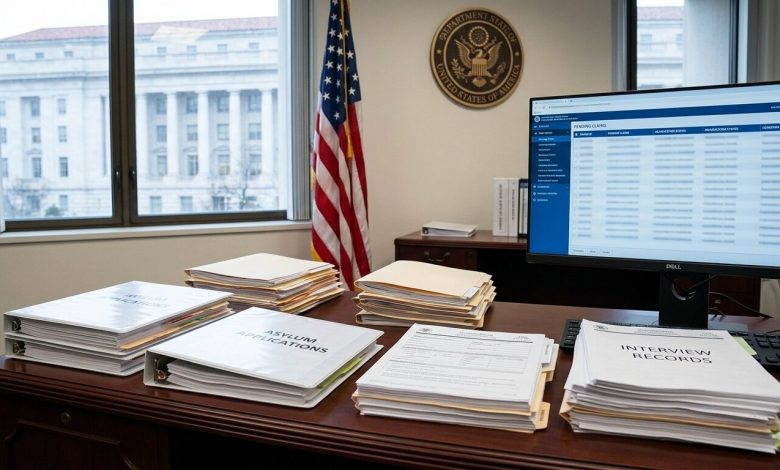
The Trump administration is drafting a policy that would allow U.S. citizenship officials to swiftly deny certain asylum claims without conducting mandatory in-person interviews.
According to internal federal documents, U.S. Citizenship and Immigration Services (USCIS) officers would gain the authority to reject applications submitted more than one year after a migrant's arrival. This fast-track framework aims to bypass traditional interview steps for late filers to aggressively cut down on the historic immigration backlog.
Table of Contents
The Administrative Shift
When we reviewed the federal draft policy, we found a distinct shift in how statutory deadlines are enforced.Current federal law requires migrants to seek asylum within 12 months of entering the United States.
However, existing regulations allow regulatory exceptions for individuals who can prove extraordinary or changed circumstances in their home nations. Under current protocols, an asylum interview serves as the primary mechanism for an applicant to explain these timeline gaps.
In our observation, skipping this conversational step completely alters the administrative architecture of immigration enforcement. By removing the interview requirement, the agency transitions from an investigative approach to a strict document-review filter. Critics and legal advocacy networks argue that this change prevents vulnerable individuals from formally presenting critical evidence regarding their timeline delays before a final administrative decision is rendered.
The Broader Context of Backlogs
The proposed policy targets an active backlog exceeding one million asylum applications currently pending within USCIS. A agency spokesperson stated that the measure would streamline adjudications and prevent personnel from wasting hours on deficient claims.
The administration plans to refer these denied applications directly to federal immigration courts. The agency spokesperson documented that this approach allows officials to avoid administrative redundancies while ensuring that individuals can still have their broader cases heard before a dedicated judge.
However, shifting these cases may inadvertently intensify pressures elsewhere in the federal pipeline. Federal data shows that the national immigration court system is already dealing with millions of pending cases. Moving hundreds of thousands of late-filed applications from USCIS directly onto court dockets could stretch the capacity of judicial infrastructure.
Declining Approval Trends
This administrative pivot aligns with a broader, long-term decline in national asylum grant rates. Data compiled by the Transactional Records Access Clearinghouse (TRAC) highlights a steady downward trajectory in successful claims.
National asylum approval rates dropped from above 50% in 2023 down to 36% by late 2024. Investigative reviews of court records show that these downward trends continued through 2025 and into early 2026.
Faced with prolonged federal delays, a growing percentage of migrants are choosing to forgo the system entirely.Rather than remaining in federal detention facilities or fighting multi-year legal battles, more individuals are accepting voluntary departure agreements. The White House explicitly referenced these results in an administrative memo, describing the structural updates as an aggressive and successful overhaul of a broken system.
Legal and Operational Obstacles
The implementation of interview-free denials will face immediate resistance from immigration attorneys and civil rights organizations. Opponents argue that the policy violates established procedural protections and strips away basic due process.
Legal challenges will likely focus on whether the executive branch possesses the authority to narrow regulatory exceptions passed by Congress. If federal courts issue injunctions against the policy, the administration may be forced to pause implementation, stalling the planned rollouts.
Operationally, USCIS personnel will need new guidelines to process applications solely on written records.Training officers to evaluate complex foreign political conditions without verbal testimony remains a significant challenge. This dynamic could lead to a high volume of appeals, potentially shifting the administrative burden rather than reducing it.





Leave a Reply
Thank you for your response.
Please verify that you are not a robot.