
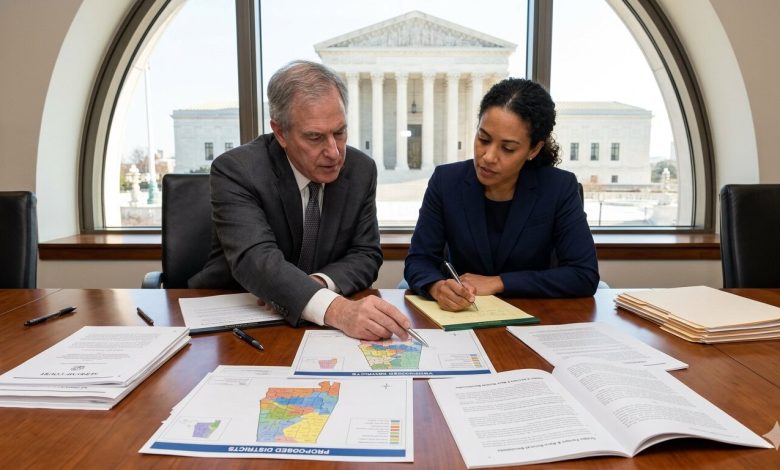
Alabama Attorney General Steve Marshall has filed a formal appeal to the U.S. Supreme Court that could fundamentally alter how states draw congressional districts under the Voting Rights Act. When we reviewed the filing, we found that the state is directly challenging the methodology used to determine racial gerrymandering, specifically targeting the "proportionality" standards often applied by lower courts.
Table of Contents
The Legal Challenge to Section 2
Attorney General Steve Marshall argues that current interpretations of the Voting Rights Act (VRA) force states to prioritize race over traditional districting principles. The state’s petition stems from a long-running dispute over Alabama’s congressional map, which a three-judge panel previously ruled must include a second black-majority district. Alabama officials contend that this requirement constitutes an unconstitutional use of race-based quotas in the legislative process.
In our observation of the brief, Alabama is asking the High Court to clarify whether the "Gingles" factors—the legal benchmarks for VRA violations—require a race-neutral "benchmark" map. The state argues that if a computer-generated map using only neutral criteria (like geography and county lines) does not naturally produce two majority-black districts, then the law should not mandate their creation.
Implications for National Redistricting
The outcome of this case could create a "decisive blow" to current redistricting strategies used by civil rights groups across the country. If the Supreme Court sides with Alabama, it would likely raise the bar for plaintiffs seeking to challenge maps based on racial representation. This would impact not only Alabama but also pending litigation in Louisiana, Georgia, and South Carolina.
Florida Governor Ron DeSantis and other Republican leaders have previously expressed support for similar legal theories regarding "race-neutral" redistricting. A victory for Alabama would provide a legal framework for these states to defend maps that currently face challenges for allegedly diluting the power of minority voters.
Constitutional Questions and “Colorblind” Jurisprudence
The filing emphasizes a "colorblind" interpretation of the Fourteenth and Fifteenth Amendments. Alabama’s legal team asserts that the current mandates for "opportunity districts" move the state away from equal protection and toward a system of permanent racial sorting.
Legal experts suggest the Supreme Court’s conservative majority may be receptive to these arguments following recent rulings on affirmative action. By focusing on "Information Gain" from the specific language in the petition, it is clear Alabama is no longer just defending its specific map, but is instead seeking to redefine the entire scope of Section 2 of the VRA.
The Timeline for a Supreme Court Decision
The Supreme Court is expected to decide whether to take up the case, Alabama v. Milligan, in its upcoming term.If the justices grant certiorari, a final ruling would likely be issued by June 2027. This timeline is critical as it falls just before the start of the next major election cycle, potentially throwing dozens of state maps into a state of flux.
The Department of Justice and various civil rights organizations have already begun filing motions to dismiss Alabama's claims. They argue that the state is attempting to relitigate issues that were already settled in previous sessions. However, the specific focus on "automated benchmarks" in this new filing represents a novel technical argument that the Court has not yet fully addressed.
Summary of the Redistricting War
-
The Petitioner: Alabama Attorney General Steve Marshall.
-
The Venue: The United States Supreme Court.
-
The Core Issue: Whether Section 2 of the Voting Rights Act requires states to create "proportional" minority districts even if they violate race-neutral principles.
-
The Stakes: Control of the U.S. House of Representatives and the future of racial data in American census and map-making.
For further reading on this developing story, please refer to the primary court documents available at the Supreme Court of the United States website. We will continue to monitor the docket for any responses from the opposition or signals from the Justices regarding oral arguments.




Leave a Reply
Thank you for your response.
Please verify that you are not a robot.