
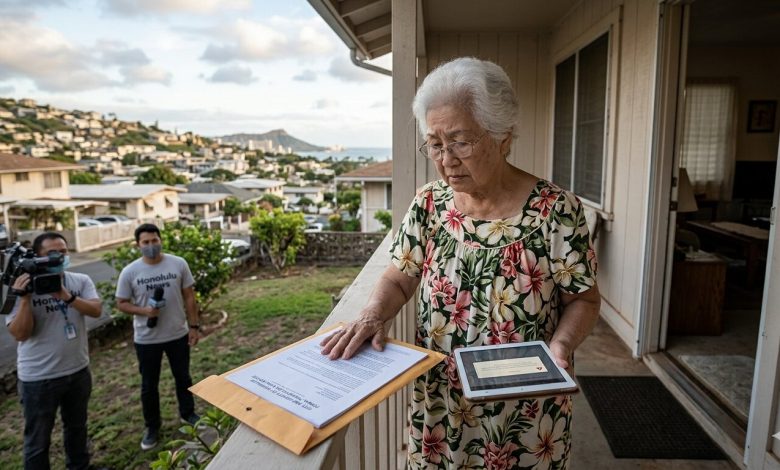
An 83-year-old Honolulu widow filed a federal lawsuit against the City and County of Honolulu after receiving a $590,000 fine stemming from a technical error on a rental listing platform. The federal lawsuit challenges the constitutionality of Honolulu's short-term rental enforcement system.
When we reviewed the filing, we found that the city levied severe financial penalties against a homeowner who was hospitalized and unable to see the notice of violation. This case highlights a major conflict between local municipal enforcement and constitutional protections against excessive government fines.
Table of Contents
The Web Listing Error and $10,000 Daily Penalties
The dispute centers around Sandra May, a Hawaii retiree who has lived in her Wilhelmina Rise home for 56 years. May relied on rental income from an attached apartment to supplement her fixed retirement income. She kept her online listing set to the city's legal 30-day minimum booking requirement.
A technical glitch occurred on the hosting platform's software system. The system accidentally permitted users to view short-term availability on her property calendar, even though no short-term stays could actually be booked.
Under Honolulu ordinances, residential properties located outside of designated resort zones cannot be advertised or rented for periods of less than 30 days. The city's automated enforcement mechanism treats any online display of short-term availability as an active advertising violation. This status immediately triggers a mandatory penalty of $10,000 per day.
Medical Emergency Prevents Timely Response
The financial penalty escalated rapidly due to an unrelated medical crisis. The city issued its formal notice of violation while May was hospitalized recovering from a serious car crash.
Because she was away from her home and undergoing medical care, May did not see the city's mailed warning. The fine accumulated at the $10,000-a-day rate for 59 consecutive days before she returned home and discovered the correspondence. By the time she contacted local zoning officials to explain the medical emergency, the total fine had reached $590,000.
City officials refused to modify or pause the penalty based on the technical glitch or her medical status. Instead, administrators instructed the elderly homeowner to secure legal counsel.
The city subsequently placed a formal property lien on May's residence. They also blocked her from accessing essential local government services, which prevents her from renewing her driver's license and vehicle registration.
Eighth Amendment Challenge to Municipal Code
The Pacific Legal Foundation stepped in to represent May, filing a lawsuit in federal court. The legal team argues that the $590,000 penalty violates the Eighth Amendment of the United States Constitution.
The Eighth Amendment bars governments from imposing excessive fines that far outweigh the severity of the underlying offense. Legal representation noted that Honolulu's short-term rental ordinance lacks a reasonable cap on daily compounding penalties, which leads to financially ruinous outcomes for simple administrative errors.
In our observation of local enforcement data cited by the legal team, Honolulu has issued more than $90 million in total fines for similar advertising violations. This indicates that May’s situation is part of a broader, systemic municipal policy targeting local property owners.
Broader Implications for Property Rights
This litigation could impact how municipalities across the country enforce short-term rental bans. Many local governments utilize automated software to scan websites like Airbnb and VRBO, issuing automated citations based entirely on digital listings rather than physical inspections.
If the federal court rules in May’s favor, it could establish a legal precedent requiring cities to implement reasonable penalty caps, mandatory warning periods, and robust appeals processes that account for medical emergencies.
The City and County of Honolulu stated that they cannot comment on the specifics of the case due to the pending federal litigation. Meanwhile, May remains in her home of five decades, facing a massive property lien that exceeds the market equity of many local residential structures.





Leave a Reply
Thank you for your response.
Please verify that you are not a robot.