
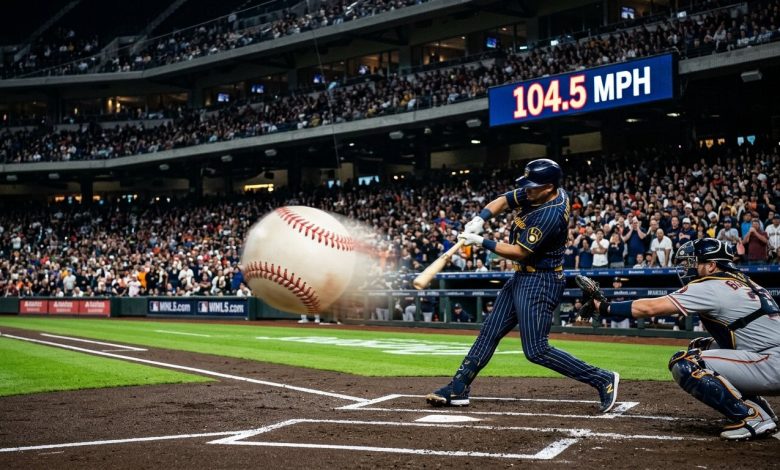
Milwaukee Brewers right-handed pitcher Jacob Misiorowski broke the Major League Baseball record for the fastest pitch ever recorded by a starting pitcher during a home game against the Philadelphia Phillies on June 12, 2026. The historic 104.5 mph fastball occurred in the top of the first inning during a five-pitch plate appearance against Phillies leadoff hitter Kyle Schwarber.
The performance established a new baseline for starting pitcher velocity, surpassing previous Statcast era records. When we reviewed the broadcast data and official tracking metrics, we found that the stadium scorebug initially rounded the pitch up to 105 mph before Major League Baseball verified the official velocity of 104.5 mph.
Table of Contents
The Record-Breaking Plate Appearance
The historic at-bat showcased unprecedented sustained velocity from a starting pitcher. Jacob Misiorowski threw five consecutive pitches to Kyle Schwarber that exceeded 103 mph.
The third pitch of the sequence registered as a called strike at 104 mph. The record-setting fifth pitch, clocked at 104.5 mph, caught the lower outside corner of the strike zone. Kyle Schwarber attempted a check swing, resulting in a foul tip that was caught by Milwaukee Brewers catcher William Contreras to complete the strikeout.
While the 104.5 mph velocity marks an all-time record for a starting pitcher, it remains below the absolute Major League Baseball velocity record held by relief pitchers. Boston Red Sox reliever Aroldis Chapman holds the fastest pitch in MLB history, throwing a 105.8 mph fastball in 2010 as a rookie with the Cincinnati Reds, followed by a 105.7 mph pitch in 2016 while playing for the Chicago Cubs.
Contextualizing Modern Pitcher Velocity
In our observation, the physical toll of sustaining triple-digit velocity remains a central concern for modern Major League organizations. The rise in maximum velocity correlates closely with the evolution of pitching mechanics and advanced biometric tracking, but it has historically introduced heightened risks for arm injuries.
Historically, starting pitchers paced themselves to maximize longevity throughout a game, making Jacob Misiorowski's sustained 103-plus mph opening sequence a shift in modern pitching strategy. Major League Baseball tracking systems indicate that starting pitchers rarely average above 98 mph over multiple innings, positioning the Milwaukee right-hander as an extreme statistical outlier.
The long-term durability of pitchers utilizing this high-velocity approach continues to divide baseball analysts. While high velocity increases strikeout rates and reduces contact quality, it places extreme stress on the ulnar collateral ligament (UCL) and shoulder capsule, often requiring organizations to monitor pitch counts and recovery metrics with strict precision.
Tracking and Verification Protocols
Major League Baseball verifies all official pitch velocities through the Statcast system, which uses high-resolution optical tracking cameras and radar technology installed at all 30 Major League stadiums. This system measures the ball's speed precisely as it leaves the pitcher's hand, ensuring a standardized metric across the league.
Stadium scorebugs frequently use data streams that round decimals to the nearest whole number for public display purposes, which explained the initial 105 mph reading on the Milwaukee broadcast. The official data pipeline corrects these figures within seconds for the permanent historical record, confirming the 104.5 mph mark.
The tracking system also monitors spin rate, extension, and vertical break, which combine with velocity to determine the overall effectiveness of a pitch. Jacob Misiorowski's extension allows the ball to appear even faster to opposing batters, minimizing the reaction time available to hitters at the plate.
Organizational Impact for Milwaukee
The Milwaukee Brewers front office faces strategic decisions regarding Jacob Misiorowski's workload following this record performance. Managing a young starting pitcher capable of reaching historical velocities requires balancing immediate competitive contributions against long-term physical preservation.
The franchise has a history of developing high-velocity arms through its pitching lab, utilizing individualized training regimens to optimize mechanical efficiency. Maintaining proper lower-body mechanics and rotational timing remains critical for pitchers throwing at these speeds to distribute force away from the elbow and shoulder joints.
As the baseball calendar progresses, opposing scouting departments must adjust to a starting pitcher capable of maintaining reliever-level velocity over multiple frames. Jacob Misiorowski's ability to locate a 104.5 mph fastball on the edge of the zone establishes a new tactical challenge for National League lineups.





Leave a Reply
Thank you for your response.
Please verify that you are not a robot.