
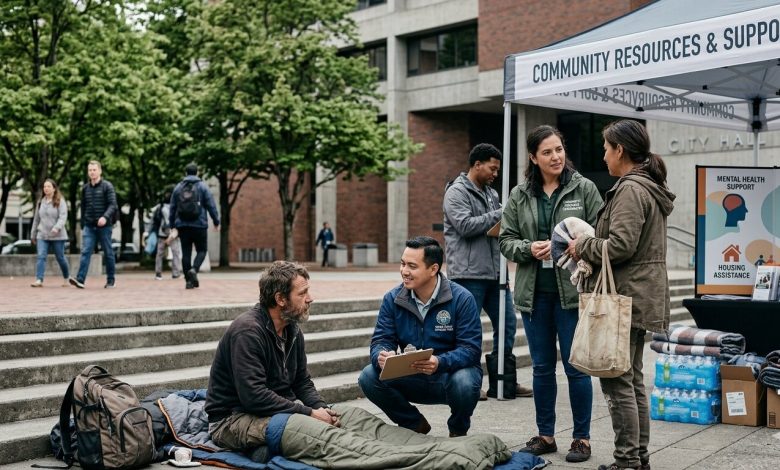
The Department of Health and Human Services (HHS), led by Secretary Robert F. Kennedy Jr., announced a $700 million federal initiative on Wednesday to address serious mental illness, substance abuse, and homelessness. The major funding injection marks a strategic expansion of the Trump administration’s public health policy, explicitly linking three historically isolated crises.
In our observation of recent agency updates, this represents the most aggressive structural shift in behavioral health funding since the administration took office. The federal government is moving away from fragmented grants toward unified community systems.
The core of the initiative is a new $96 million grant program named Safety Through Recovery, Engagement, and Evidence-Based Treatment and Supports (STREETS). This program targets state, local, and tribal governments to build integrated housing and addiction recovery networks.
Table of Contents
The Structural Strategy of the STREETS Program
When we reviewed the program details released by HHS, we found that the STREETS framework mandates local operational convergence. Participating communities must establish formal coordination between healthcare providers, local governments, law enforcement, and local court systems.
The program is designed to create a single point of entry for vulnerable individuals rather than forcing them to navigate multiple municipal agencies.
Initial funding structures indicate that eight specific grant recipients will be selected during the first phase of rollouts. Each recipient will be eligible to receive up to $3 million annually over a four-year period.
HHS documents emphasize that these communities must demonstrate rapid deployment capabilities to secure the multi-year renewals. Local agencies are expected to move individuals into long-term recovery and stable housing while actively tracking data.
Shift to Integrated Public Health Models
Instead of treating homelessness as a standalone economic or housing issue, HHS is explicitly framing chronic homelessness as a behavioral health emergency.
"For too long, America has treated homelessness, mental illness and addiction as separate problems," Health and Human Services Secretary Robert F. Kennedy Jr. stated during the announcement. "The reality is that these crises are deeply interconnected."
Our analysis of prior federal health allocations shows that separate funding streams often caused local non-profits to compete against municipal health departments. By consolidating resources under a broader $700 million umbrella, HHS intends to force local agencies into single, data-driven recovery frameworks.
The department’s stated goal is to reduce long-term reliance on emergency rooms, municipal shelters, and the criminal justice system. These three sectors currently absorb the highest fiscal impact from uncoordinated behavioral health crises.
Accountability, Timelines, and Funding Logistics
The STREETS initiative heavily emphasizes measurable metrics, a policy signature that aligns with the administration's broader approach to federal spending. Grant recipients must prove local service integration leads to verifiable drops in local emergency room admissions and recidivism.
Federal officials confirmed that grant applications will become available to state and local entities in the coming weeks.
The formal evaluation process will conclude later this year, with initial funding awards scheduled for distribution before the end of the fiscal cycle. Local municipalities are already adjusting their upcoming budgets to meet the coordination requirements necessary to qualify for the $3 million annual caps.
This $700 million investment comes amidst rising national pressure on municipal governments to manage public encampments and addiction spikes. By providing direct federal funding tied to law enforcement and court cooperation, the administration is shifting local enforcement models toward a treatment-first paradigm.





Leave a Reply
Thank you for your response.
Please verify that you are not a robot.