
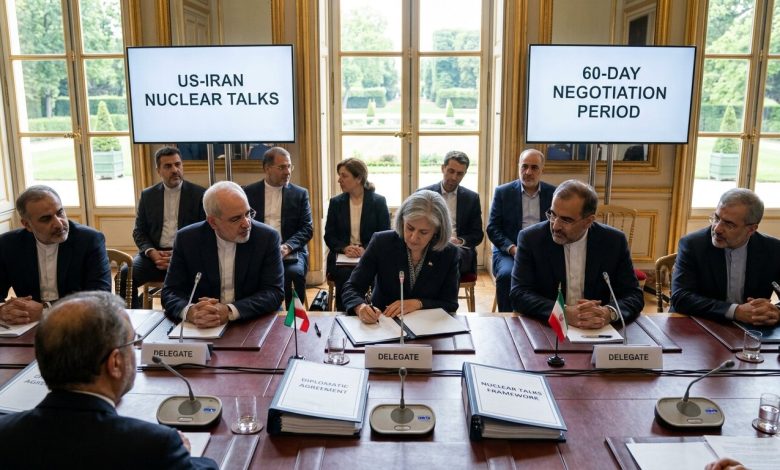
The United States and Iran have entered a 60-day negotiation period after President Donald Trump signed a historic memorandum of understanding (MOU) at the Palace of Versailles. The agreement, signed alongside Iranian leadership and Pakistani Prime Minister Shehbaz Sharif acting as a moderator, establishes an immediate ceasefire framework while broader nuclear talks continue.
In our review of the initial implementation steps on June 18, 2026, the diplomatic shift has already triggered sweeping changes to military operations and global energy markets.
Table of Contents
CENTCOM Halts Maritime Blockade as 60-Day Clock Begins
The US military has officially ended its naval enforcement actions against Iranian ports. Following directives tied to the Versailles MOU, U.S. Central Command (CENTCOM) confirmed via public statements that its maritime blockade on traffic entering and exiting Iranian coastal areas has ceased.
CENTCOM noted that while American forces are no longer impeding merchant vessels in the Arabian Gulf or the Gulf of Oman, high-value naval warships will remain positioned in the region to monitor compliance.
Vice President JD Vance confirmed the 60-day negotiating window is now active. Speaking at a White House press briefing on Thursday, Vice President Vance stated that the timeline serves as a performance test for Tehran. He emphasized that the United States is not transferring any funds upfront and that economic adjustments or sanctions relief depend entirely on verifiable changes in Iranian behavior.
Market Reacts to Resumed Hormuz Shipping Traffic
Global energy markets responded immediately to the diplomatic breakthrough as shipping lanes reopened.According to White House briefing data, approximately 12.5 million barrels of oil successfully transited the Strait of Hormuz during the first night following the signing. This surge marks the highest single-night volume since regional hostilities began and coincided with a consecutive second night of zero Iranian maritime attacks.
Domestic fuel costs have concurrently experienced a downward correction. Data from AAA indicates that national average gas prices dipped below $4 per gallon for the first time since the escalation of the conflict. Additionally, President Trump publicly addressed speculation surrounding the deal on Truth Social, explicitly denying reports of an immediate $300 billion payment to Iran, labeling the claims inaccurate and framing the market shifts as a domestic economic victory.
Regional Allies Split Over Versailles Framework
Israeli Prime Minister Benjamin Netanyahu responded to the MOU by reinforcing Israel's independent defense posture. During an official ceremony on Thursday, Prime Minister Netanyahu stated that the Israel Defense Forces (IDF) will maintain their security zone in southern Lebanon indefinitely to protect northern communities from Hezbollah. While acknowledging the diplomatic developments, Netanyahu reiterated his administration's absolute red line, documenting that Israel will prevent Iran from acquiring nuclear weapons under any circumstance.
The White House issued a direct response to international and domestic critics of the temporary framework.Addressing pushback from certain members of the Israeli Cabinet, Vice President Vance noted that two-thirds of Israel's defensive weapons over the past three months were supplied via American funding and manufacturing. Vance defended President Trump’s strategy, arguing that the administration remains Israel's primary global ally and that the MOU leverages significant US economic pressure to force compliance from Tehran.




Leave a Reply
Thank you for your response.
Please verify that you are not a robot.