
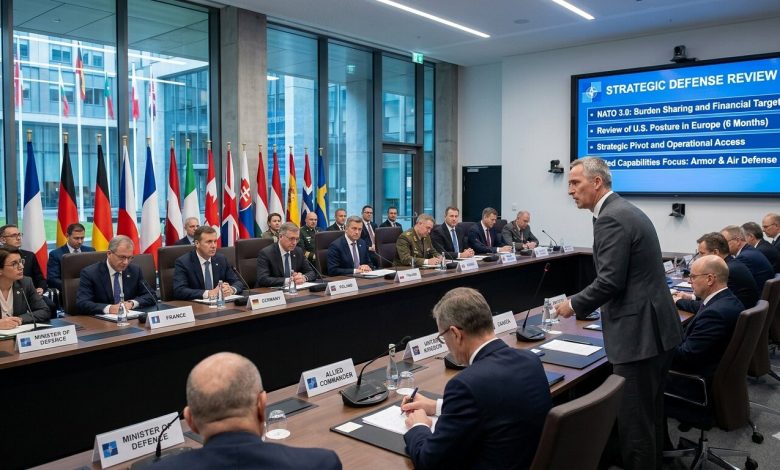
U.S. Defense Secretary Pete Hegseth announced a sweeping six-month review of the American military presence in Europe on June 18, 2026, during a meeting of NATO defense ministers in Brussels. This strategic assessment intends to shift primary conventional defense responsibilities directly to European member states, creating what the administration terms "NATO 3.0." The policy directive establishes that future U.S. financial contributions and troop deployments will depend strictly on allies meeting defense spending metrics and providing unrestricted operational access.
Table of Contents
Transatlantic Realignment Under NATO 3.0
The structural review will evaluate all U.S. basing, overflight permissions, and force deployments across the European continent. Air Force Gen. Alexus Grynkewich, the commander of U.S. European Command and Supreme Allied Commander Europe, will lead the assessment. When we reviewed the official briefings from the meeting, we found that the administration plans to coordinate directly with the U.S. Congress and allied capitals throughout the six-month window.
The ultimate objective is a fundamental rebalancing of the transatlantic alliance. Defense Secretary Hegseth stated that the current arrangement operates as a one-way street rather than a shared burden-sharing mechanism. The administration emphasized that American strategic priorities must pivot toward the Indo-Pacific region and the Western Hemisphere. Consequently, European nations must take the primary role in maintaining their own continental defense infrastructure.
This policy shift follows recent unilateral drawdowns executed by the Pentagon. Washington recently finalized the withdrawal of 5,000 U.S. troops from Germany following prolonged strategic disagreements between President Donald J. Trump and German Chancellor Friedrich Merz. Furthermore, the War Department canceled a highly anticipated deployment of a long-range fire battalion to German soil. These actions underscore a broader retrenchment of American hard power assets from legacy European installations.
Strategic Posture and Financial Contingencies
The financial mechanisms binding the United States to NATO are undergoing immediate structural alterations.Washington currently covers approximately 15% of NATO’s direct organizational operating budget, which translates to roughly $790 million for the 2026 fiscal year. Defense Secretary Hegseth documented that future payments will be strictly contingent upon individual member states achieving agreed-upon domestic defense spending targets.
-
Dues Reduction: The United States will systematically decrease its direct financial contributions to the alliance's administrative budget if partners fail to spend with urgency.
-
Target Enforcement: Member nations are expected to accelerate timelines to hit the upgraded 5% GDP defense spending threshold established during the recent Hague Summit.
-
Capabilities Focus: The Pentagon is demanding that European procurement shift away from administrative initiatives and prioritize conventional combat assets, including Main Battle Tanks, advanced fighter aircraft, and localized air defense networks.
NATO Secretary General Mark Rutte attempted to mitigate alliance anxieties by highlighting recent financial progress among member states. European allies and Canada collectively increased their defense investments by more than $90 billion over the past year. However, U.S. officials maintain that these increases remain unevenly distributed across the 32-nation bloc. The Trump administration countered by noting that U.S. defense spending is projected to exceed $1 trillion in 2026 and reach $1.5 trillion in 2027.
Operational Fallout from the Iran Conflict
The structural review was heavily accelerated by deep diplomatic friction over European participation in the recent U.S. military operations against Iran. The Pentagon chief lambasted several European allies for denying American forces airspace access and basing usage during active hostilities. Washington considers these operational restrictions an unacceptable risk to American military personnel deployed in the region.
The operational division between specific European nations during the conflict highlighted growing tactical fragmentation. The United Kingdom permitted U.S. strategic bombers to operate directly out of RAF Fairford, facilitating the largest overseas deployment of American B-1 Lancers and B-52 Stratofortresses in modern history. Conversely, Spain completely denied the U.S. military access to its facilities for strike missions, forcing complex rerouting.
The upcoming NATO annual summit in Ankara, Turkey, will serve as the next focal point for these geopolitical negotiations. Allied defense ministers expressed concern regarding the sudden reduction of U.S. assets committed to the collective NATO Force Model pool. The upcoming talks will determine how European militaries intend to fill the localized capability gaps left by departing American aircraft carrier strike groups and cruise-missile-capable submarines.
This Hegseth NATO 3.0 Address Analysis provides a detailed overview of the Defense Secretary's speech in Brussels, highlighting the strategic shifts and the specific defense spending demands imposed on European allies.





Leave a Reply
Thank you for your response.
Please verify that you are not a robot.